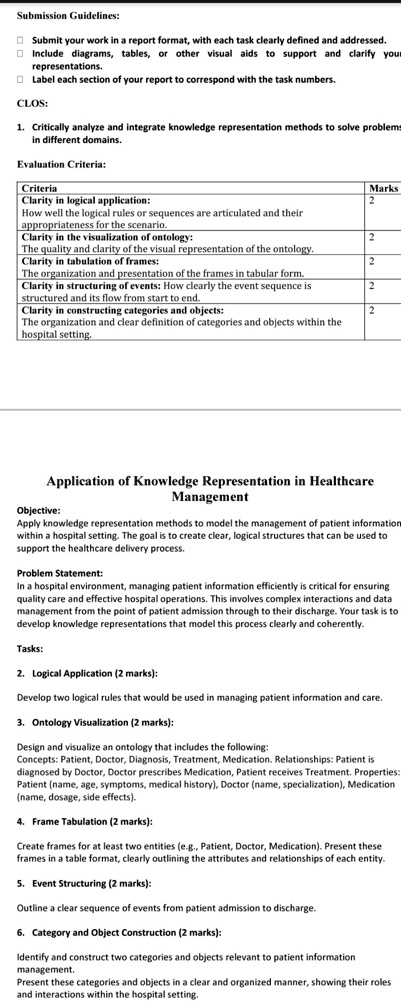
Submission Guidelines:
Submit your work in a report format, with each task clearly defined and addressed.
Include diagrams, tables, or other visual aids to support and clarify your representations.
Label each section of your report to correspond with the task numbers.
CLOS:
1. Critically analyze and integrate knowledge representation methods to solve problems in different domains.
Evaluation Criteria:
Criteria
Marks
Clarity in logical application: How well the logical rules or sequences are articulated and their appropriateness for the scenario. 2
Clarity in the visualization of ontology: The quality and clarity of the visual representation of the ontology. 2
Clarity in tabulation of frames: The organization and presentation of the frames in tabular form. 2
Clarity in structuring of events: How clearly the event sequence is structured and its flow from start to end. 2
Clarity in constructing categories and objects: The organization and clear definition of categories and objects within the hospital setting. 2
Application of Knowledge Representation in Healthcare Management
Objective:
Apply knowledge representation methods to model the management of patient information within a hospital setting. The goal is to create clear, logical structures that can be used to support the healthcare delivery process.
Problem Statement:
In a hospital environment, managing patient information efficiently is critical for ensuring quality care and effective hospital operations. This involves complex interactions and data management from the point of patient admission through to their discharge. Your task is to develop knowledge representations that model this process clearly and coherently.
Tasks:
2. Logical Application (2 marks):
Develop two logical rules that would be used in managing patient information and care.
3. Ontology Visualization (2 marks):
Design and visualize an ontology that includes the following:
Concepts: Patient, Doctor, Diagnosis, Treatment, Medication. Relationships: Patient is diagnosed by Doctor, Doctor prescribes Medication, Patient receives Treatment. Properties: Patient (name, age, symptoms, medical history), Doctor (name, specialization), Medication (name, dosage, side effects).
4. Frame Tabulation (2 marks):
Create frames for at least two entities (e.g., Patient, Doctor, Medication). Present these frames in a table format, clearly outlining the attributes and relationships of each entity.
5. Event Structuring (2 marks):
Outline a clear sequence of events from patient admission to discharge.
6. Category and Object Construction (2 marks):
Identify and construct two categories and objects relevant to patient information management.
Present these categories and objects in a clear and organized manner, showing their roles and interactions within the hospital setting.