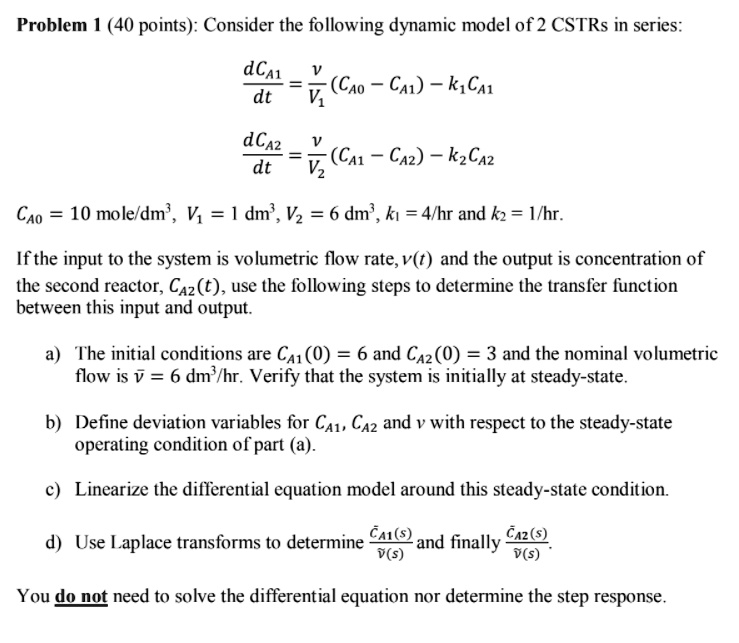
Problem 1 (40 points): Consider the following dynamic model of 2 CSTRs in series:
$\frac{dC_{A1}}{dt} = \frac{\nu}{V_1}(C_{A0} - C_{A1}) - k_1C_{A1}$
$\frac{dC_{A2}}{dt} = \frac{\nu}{V_2}(C_{A1} - C_{A2}) - k_2C_{A2}$
$C_{A0} = 10 \text{ mole/dm}^3, V_1 = 1 \text{ dm}^3, V_2 = 6 \text{ dm}^3, k_1 = 4/\text{hr and } k_2 = 1/\text{hr}$.
If the input to the system is volumetric flow rate, $v(t)$ and the output is concentration of
the second reactor, $C_{A2}(t)$, use the following steps to determine the transfer function
between this input and output.
a) The initial conditions are $C_{A1}(0) = 6$ and $C_{A2}(0) = 3$ and the nominal volumetric
flow is $\bar{v} = 6 \text{ dm}^3/\text{hr}$. Verify that the system is initially at steady-state.
b) Define deviation variables for $C_{A1}$, $C_{A2}$ and $v$ with respect to the steady-state
operating condition of part (a).
c) Linearize the differential equation model around this steady-state condition.
d) Use Laplace transforms to determine $\frac{\hat{C}_{A1}(s)}{V(s)}$ and finally $\frac{\hat{C}_{A2}(s)}{V(s)}$.
You do not need to solve the differential equation nor determine the step response.