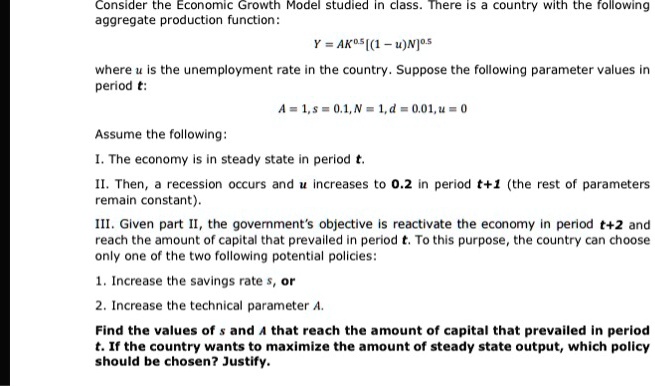
Consider the Economic Growth Model studied in class. There is a country with the following aggregate production function:
\(Y = AK^{0.5}[(1 - u)N]^{0.5}\)
where \(u\) is the unemployment rate in the country. Suppose the following parameter values in period \(t\):
\(A = 1, s = 0.1, N = 1, d = 0.01, u = 0\)
Assume the following:
I. The economy is in steady state in period \(t\).
II. Then, a recession occurs and \(u\) increases to 0.2 in period \(t+1\) (the rest of parameters remain constant).
III. Given part II, the government's objective is reactivate the economy in period \(t+2\) and reach the amount of capital that prevailed in period \(t\). To this purpose, the country can choose only one of the two following potential policies:
1. Increase the savings rate \(s\), or
2. Increase the technical parameter \(A\).
Find the values of \(s\) and \(A\) that reach the amount of capital that prevailed in period \(t\). If the country wants to maximize the amount of steady state output, which policy should be chosen? Justify.