Ace - AI Tutor
Ask Our Educators
Textbooks
My Library
Flashcards
Scribe - AI Notes
Notes & Exams
Download App
jerome arrieta

jerome a.

Divider

Questions asked

BEST MATCH

What movements are permitted by the elbow joint located between the humerus and the ulna? Multiple Choice Movement in any plane Flexion and extension Rotation and circumduction Adduction, flexion, and extension

View Answer
divider
BEST MATCH

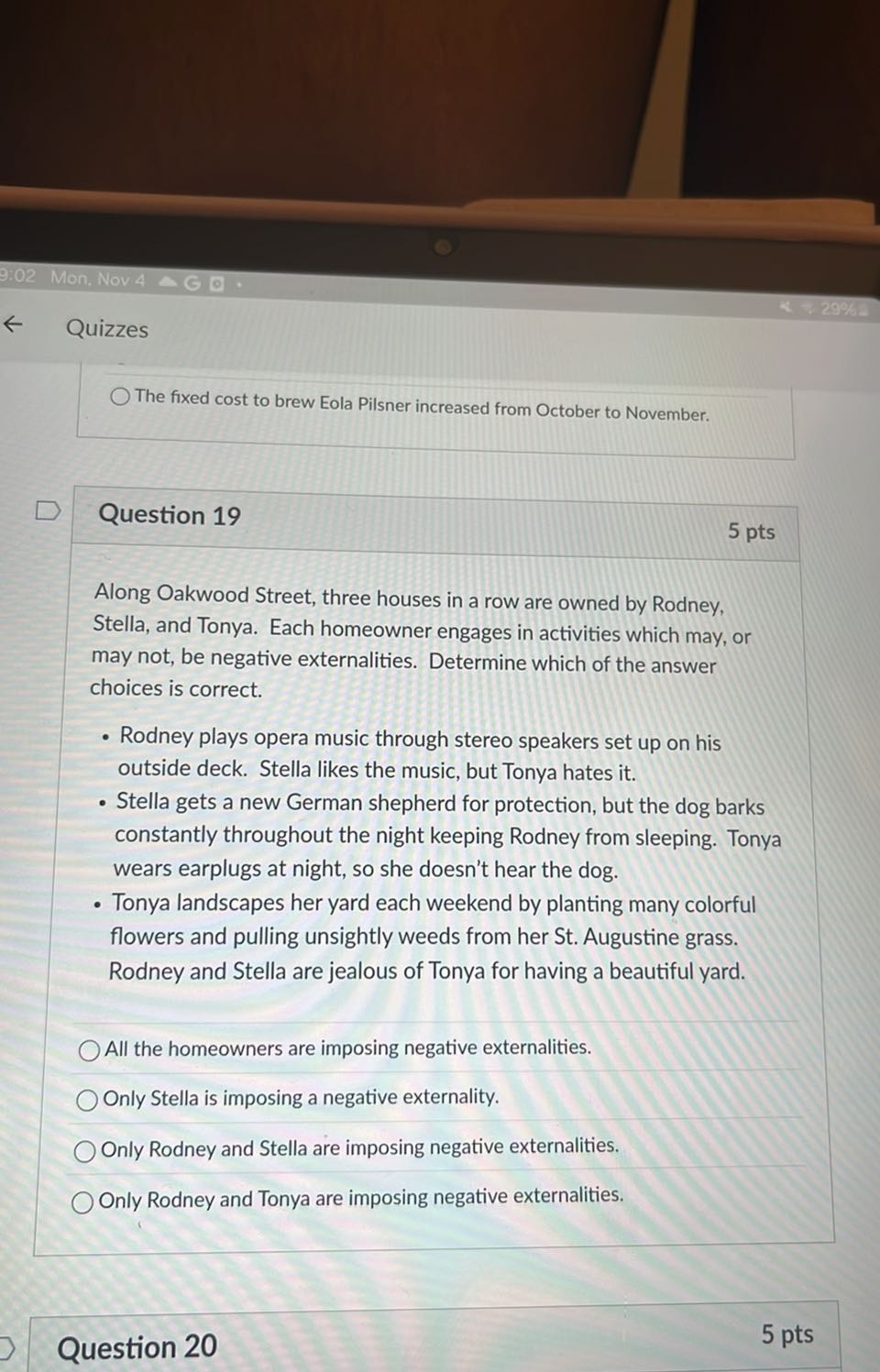
Mon. Nov Quizzes The fixed cost to brew Eola Pilsner increased from October to November. \( \square \) Question 19 5 pts Along Oakwood Street, three houses in a row are owned by Rodney, Stella, and Tonya. Each homeowner engages in activities which may, or may not, be negative externalities. Determine which of the answer choices is correct. - Rodney plays opera music through stereo speakers set up on his outside deck. Stella likes the music, but Tonya hates it. - Stella gets a new German shepherd for protection, but the dog barks constantly throughout the night keeping Rodney from sleeping. Tonya wears earplugs at night, so she doesn't hear the dog. - Tonya landscapes her yard each weekend by planting many colorful flowers and pulling unsightly weeds from her St. Augustine grass. Rodney and Stella are jealous of Tonya for having a beautiful yard. All the homeowners are imposing negative externalities. Only Stella is imposing a negative externality. Only Rodney and Stella are imposing negative externalities. Only Rodney and Tonya are imposing negative externalities. Question 20 5 pts
View Answer
divider
BEST MATCH

Alcohol intake in smokers is strongly associated with cancers of the O prostate. O endometrium. O kidneys. O head and neck.

View Answer
divider
BEST MATCH

rewrite According to supporters of queer theory, gender identity is not a rigid or static identity but can continue to evolve and change over time. Queer theory developed in response to the perceived limitations of the way in which identities are thought to become consolidated or stabilized (for instance, gay or straight), and theorists constructed queerness in an attempt to resist this.

View Answer
divider
BEST MATCH

Consider a cell at 37°C in which [K+] = 100.0 mM inside the cell and [K+] = 5.00 mM outside the cell. Potassium ion channels are open, but there is no net movement of K+ into or out of the cell. No other ion channels are open. What is the membrane potential of the cell?

View Answer
divider
BEST MATCH

Reading is fun (1) What happened to the sparrows one day? (1) Where did the sparrows live? (1) Why could not the he-sparrow save the eggs? What did the old owl do with the neckless? (i) What did the guard do with the snake?

View Answer
divider
BEST MATCH

Question 4 (25 points) Consider the following structure of the force of interest per unit of time: { ?(t) = 0.05 if 0 < t ? 2, ?(t) = 0.03 + 0.01t if 2 ? t ? 5, ?(t) = 0.03 + 0.002t² if 5 < t. (a) Calculate, consistently with the previously mentioned interest rate force, the equivalent rate for an investment from t=0 to 8 years. (b) Determine the accumulated value if you invest 100 EUR at t=0. (c) Compute the accumulated value at t=8 years when investing a cash flow stream defined by the following function: 100 – 5t (d) What is the accumulated value of the cash flow stream when we consider a zero interest rate level? (e) Find the present value of the cash flow stream considering the interest force structure previously provided.

View Answer
divider
BEST MATCH

An investor short sells 600 shares of a stock for $39 per share. The initial margin is 47%. How much equity will be required in the account to complete this transaction? The initial margin deposit is $ \boxed{} (Round to the nearest dollar.)

View Answer
divider
BEST MATCH

Text: Use the Remainder Theorem to determine the remainder when P(x) is divided by x-r. P(x) = x^4 - 16, x - 2.

View Answer
divider
BEST MATCH

4. Consider the following predicate: ((a ? b) ? c ? ¬(d ? e)) ? (f = g), where a, b, d, e, f and g are integer variables and c is a Boolean variable. a) Use the BRO-CSET procedure to derive the constraint set for this predicate. (20 points) b) Generate test cases for the constraint set you have derived in a). (5 points) 2.1 N is an OR-node: $S_N^f = S_{N_1}^f ? S_{N_2}^f$ $S_N^f = (S_{N_1}^f × {t_1}) ? ({t_1} × S_{N_2}^f)$ where $t_1 ? S_{N_1}^f$ and $t_2 ? S_{N_2}^f$ 2.2 N is an AND-node: $S_N^f = S_{N_1}^f ? S_{N_2}^f$ $S_N^f = (S_{N_1}^f × {t_1}) ? ({t_1} × S_{N_2}^f)$ where $t_1 ? S_{N_1}^f$ and $t_2 ? S_{N_2}^f$ 2.3 N is NOT-node: $S_N^f = S_{N_1}^f$ $S_N^f = S_{N_1}^f

View Answer
divider