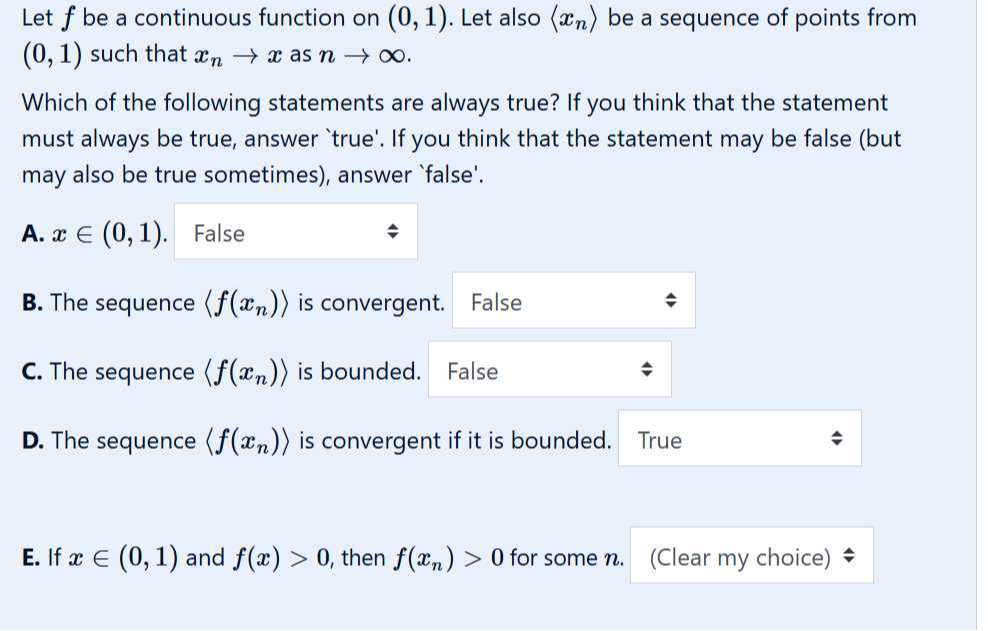
Let \( f \) be a continuous function on \( (0,1) \). Let also \( \left\langle x_{n}\right\rangle \) be a sequence of points from \( (0,1) \) such that \( x_{n} \rightarrow x \) as \( n \rightarrow \infty \).
Which of the following statements are always true? If you think that the statement must always be true, answer 'true'. If you think that the statement may be false (but may also be true sometimes), answer 'false'.
A. \( x \in(0,1) \). False
B. The sequence \( \left\langle f\left(x_{n}\right)\right\rangle \) is convergent. False
C. The sequence \( \left\langle f\left(x_{n}\right)\right\rangle \) is bounded. \( \square \)
D. The sequence \( \left\langle f\left(x_{n}\right)\right\rangle \) is convergent if it is bounded. True \( \square \)
E. If \( x \in(0,1) \) and \( f(x)>0 \), then \( f\left(x_{n}\right)>0 \) for some \( n \). (Clear my choice) \( \boldsymbol{\vartheta} \)