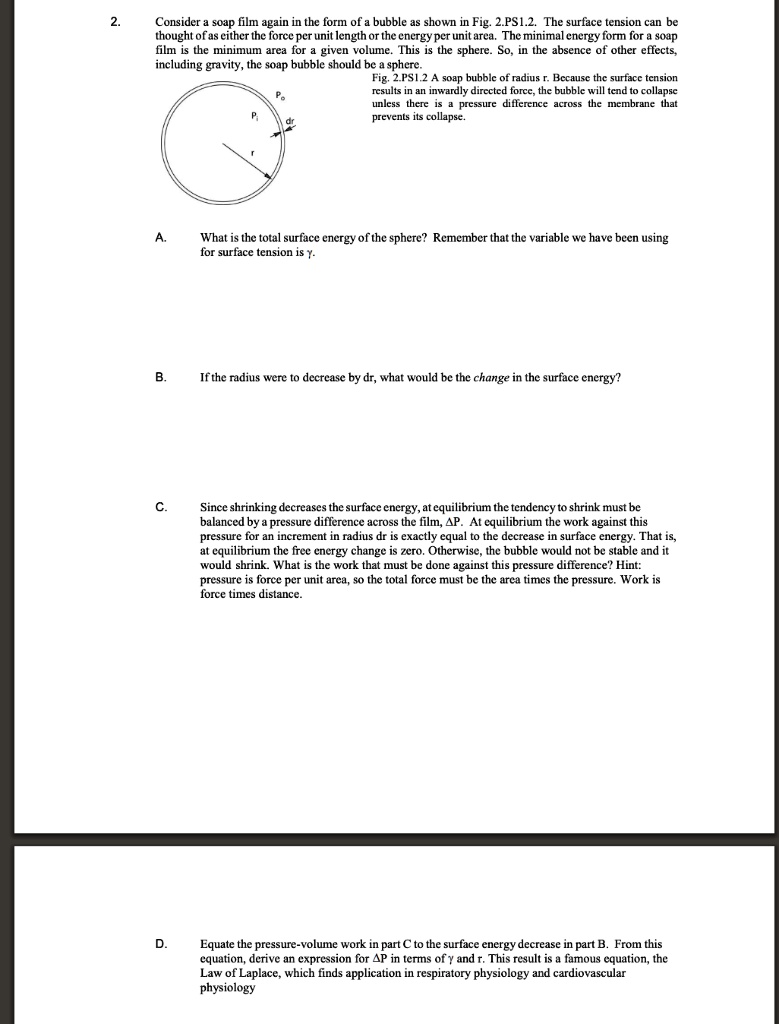
Consider a soap film again in the form of a bubble as shown in Fig. 2.PS1.2. The surface tension can be thought of as either the force per unit length or the energy per unit area. The minimal energy form for a soap film is the minimum area for a given volume. This is the sphere. So, in the absence of other effects, including gravity, the soap bubble should be a sphere. Fig. 2.PS1.2: A soap bubble of radius r. Because the surface tension results in an inwardly directed force, the bubble will tend to collapse unless there is a pressure difference across the membrane that prevents its collapse.
A. What is the total surface energy of the sphere? Remember that the variable we have been using for surface tension is σ.
B. If the radius were to decrease by dr, what would be the change in the surface energy?
C. Since shrinking decreases the surface energy, at equilibrium the tendency to shrink must be balanced by a pressure difference across the film, P. At equilibrium, the work against this pressure for an increment in radius dr is exactly equal to the decrease in surface energy. That is, at equilibrium, the free energy change is zero. Otherwise, the bubble would not be stable and it would shrink. What is the work that must be done against this pressure difference? Hint: pressure is force per unit area, so the total force must be the area times the pressure. Work is force times distance.
D. Equate the pressure-volume work in part C to the surface energy decrease in part B. From this equation, derive an expression for P in terms of σ and r. This result is a famous equation, the Law of Laplace, which finds application in respiratory physiology and cardiovascular physiology.