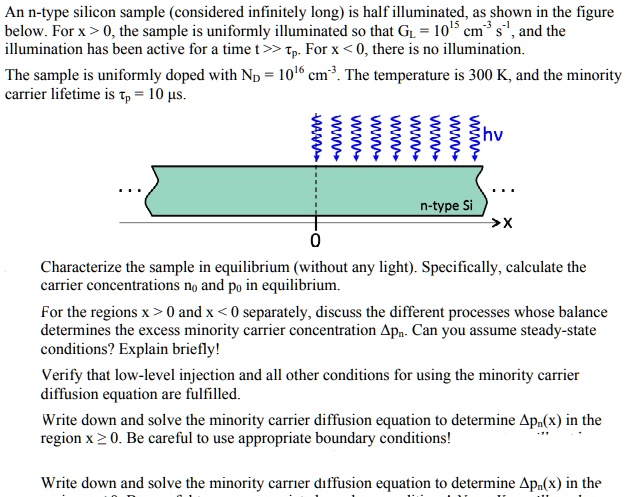
An n-type silicon sample (considered infinitely long) is half illuminated, as shown in the figure
below. For x > 0, the sample is uniformly illuminated so that $G_L = 10^{15} \text{cm}^{-3} \text{s}^{-1}$, and the
illumination has been active for a time $t >> \tau_p$. For x < 0, there is no illumination.
The sample is uniformly doped with $N_D = 10^{16} \text{cm}^{-3}$. The temperature is 300 K, and the minority
carrier lifetime is $\tau_p = 10 \text{ \mu s}$.
..
0
hv
..
n-type Si
>X
Characterize the sample in equilibrium (without any light). Specifically, calculate the
carrier concentrations $n_0$ and $p_0$ in equilibrium.
For the regions x > 0 and x < 0 separately, discuss the different processes whose balance
determines the excess minority carrier concentration $\Delta p_n$. Can you assume steady-state
conditions? Explain briefly!
Verify that low-level injection and all other conditions for using the minority carrier
diffusion equation are fulfilled.
Write down and solve the minority carrier diffusion equation to determine $\Delta p_n(x)$ in the
region x ? 0. Be careful to use appropriate boundary conditions!
Write down and solve the minority carrier diffusion equation to determine $\Delta p_n(x)$ in the