Ace - AI Tutor
Ask Our Educators
Textbooks
My Library
Flashcards
Scribe - AI Notes
Notes & Exams
Download App
jes-s snyder

jes-s s.

Divider

Questions asked

BEST MATCH

Under which of the following conditions is one most likely to have the most detrimental effects on the body? A short term stressor, where we believe we do have control over the outcome of stressful event A short term stressor, where we believe we have no control over the outcome of stressful event A long term stressor, where we believe we do have control over the outcome of a stressful event A long term stressor, where we believe we have no control over the outcome of a stressful event

View Answer
divider
BEST MATCH

What is the key benefit of logging to either a central log server or, on a larger scale, to a Security Incident and Event Management System? Question 7Select one: a. Logging remotely eliminates the administrative burden of local log managment b. Logging to a remote machine prevents an adversary from tampering with the logs c. It allows for more sophisticated analysis d. It prevents log files from filling up the local drive space

View Answer
divider
BEST MATCH

Which of the following commonly decline with older age? selective attention and procedural memory crystallized intelligence and procedural memory divided attention and episodic memory attentional blindness and wisdom

View Answer
divider
BEST MATCH

Find the domain of the function using interval notation. $f(x) = \sqrt{16 - 15x}$

View Answer
divider
BEST MATCH

Given a set U = {1, 2, 3, 4, 5, 6, 7, 8, 9, 10, 11 } and three of its subsets as follows: R = {1, 2, 3, 4, 5} S = {2, 4, 8} T = {1, 3, 9} Find out the elements in the set: $(T \cup S) \cap R^c$ What elements are in the set: $R - (S \cup (T - R))$ Find out the Power set of S = $P(S)$ Find out the set of ordered pairs in: $S \times T$ Find out the elements in the set: $(T^c - R^c)^c$

View Answer
divider
BEST MATCH

How many grams of XeF6 are formed from 12.9 mL of F2 (at 25 °C and 2.60 atm) according to the following reaction? Xe(g) + 3 F2(g) → XeF6(g) You must show your work/calculations for this question. You can handwrite or type your answer. Upload your file containing the answer for this question below.

View Answer
divider
BEST MATCH

The count in a bacteria culture was 200 after 15 minutes and 1900 after 35 minutes. Assuming the count grows exponentially. You may enter the exact value or round to 2 decimal places. What was the initial size of the culture?

View Answer
divider
BEST MATCH

48. An electron in a hydrogen atom is in a state given by the wave function $\psi(\vec{r}) = \frac{1}{\sqrt{3\pi a^5}}re^{-r/a}$. (a) What is the value of $l$ for this state? (b) Find the probability that a measurement of the energy of this electron will give the value -13.6 eV. Here, $a$ is the Bohr radius.

View Answer
divider
BEST MATCH

Question 5: Find the equivalent money for Trevor Immelman's prize in year 2008, stated in terms of year 2006 dollars. Consumer Prize Money (in Price Veur Maner Actual Dollars) Index Inflation Rate Equivalent Priso Money (In 2011 Dollues) 2006 Phil Mickelson $1,260,000 201.5 $1,397,568 2007 Zach Johnson $1,305,000 206.7 2.58% $1,411,067 2008 Trevor Immelman $1,350,000 214.8 3.92% $1,404,679 2009 Angel Cabrera $1,350,000 213.2 -0.74% $1,415,220 2010 Phil Mickelson $1,350,000 218.0 2.25% $1,384,060 2011 Charl Schwartzel $1,440,000 223.5 2.52% $1,440,000

View Answer
divider
BEST MATCH

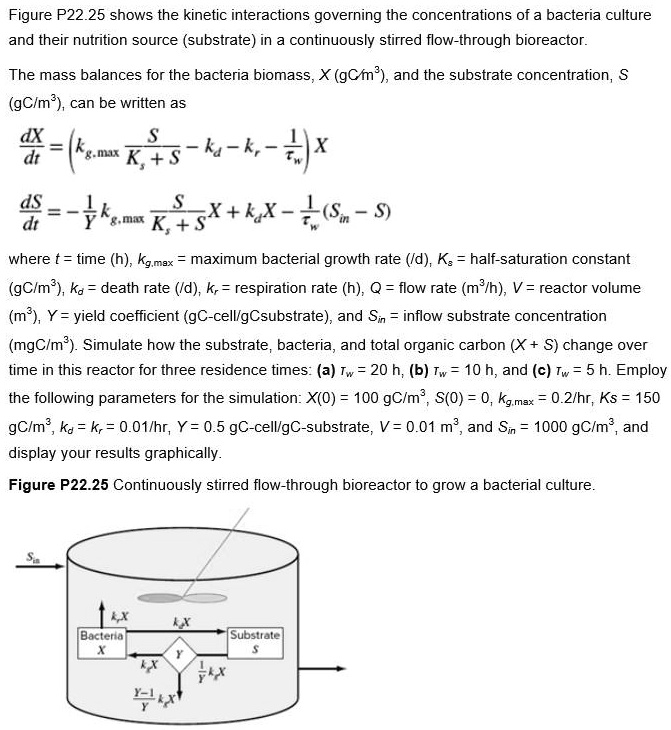
Figure P22.25 shows the kinetic interactions governing the concentrations of a bacteria culture and their nutrition source (substrate) in a continuously stirred flow-through bioreactor. The mass balances for the bacteria biomass, X (gC/m³), and the substrate concentration, S (gC/m³), can be written as \frac{dX}{dt} = \left(k_{g,max}\frac{S}{K_S+S} - k_d - k_r - \frac{1}{\tau_w}\right)X \frac{dS}{dt} = -\frac{1}{Y}k_{g,max}\frac{S}{K_S+S}X + k_dX - \frac{1}{\tau_w}(S - S_{in}) where t = time (h), $k_{g,max}$ = maximum bacterial growth rate (/d), $K_S$ = half-saturation constant (gC/m³), $k_d$ = death rate (/d), $k_r$ = respiration rate (h), Q = flow rate (m³/h), V = reactor volume (m³), Y = yield coefficient (gC-cell/gCsubstrate), and $S_{in}$ = inflow substrate concentration (mgC/m³). Simulate how the substrate, bacteria, and total organic carbon (X + S) change over time in this reactor for three residence times: (a) $\tau_w$ = 20 h, (b) $\tau_w$ = 10 h, and (c) $\tau_w$ = 5 h. Employ the following parameters for the simulation: X(0) = 100 gC/m³, S(0) = 0, $k_{g,max}$ = 0.2/hr, $K_S$ = 150 gC/m³, $k_d$ = $k_r$ = 0.01/hr, Y = 0.5 gC-cell/gC-substrate, V = 0.01 m³, and $S_{in}$ = 1000 gC/m³, and display your results graphically. Figure P22.25 Continuously stirred flow-through bioreactor to grow a bacterial culture.
View Answer
divider