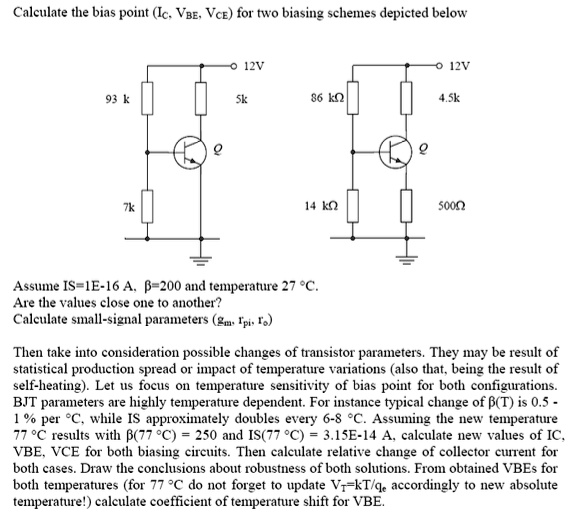
Calculate the bias point (Ic, VBE, VCE) for two biasing schemes depicted below
12V
12V
93 k
5k
86 k$\Omega$
4.5k
7k
$\Omega$
2
14 k$\Omega$
500$\Omega$
Assume IS=1E-16 A, $\beta$=200 and temperature 27 $^\circ$C.
Are the values close one to another?
Calculate small-signal parameters ($g_m$, $r_{pi}$, $r_o$)
Then take into consideration possible changes of transistor parameters. They may be result of
statistical production spread or impact of temperature variations (also that, being the result of
self-heating). Let us focus on temperature sensitivity of bias point for both configurations.
BJT parameters are highly temperature dependent. For instance typical change of $\beta$(T) is 0.5 -
1 % per $^\circ$C, while IS approximately doubles every 6-8 $^\circ$C. Assuming the new temperature
77 $^\circ$C results with $\beta$(77 $^\circ$C) = 250 and IS(77 $^\circ$C) = 3.15E-14 A, calculate new values of IC,
VBE, VCE for both biasing circuits. Then calculate relative change of collector current for
both cases. Draw the conclusions about robustness of both solutions. From obtained VBEs for
both temperatures (for 77 $^\circ$C do not forget to update $V_T$=kT/q$_e$ accordingly to new absolute
temperature!) calculate coefficient of temperature shift for VBE.