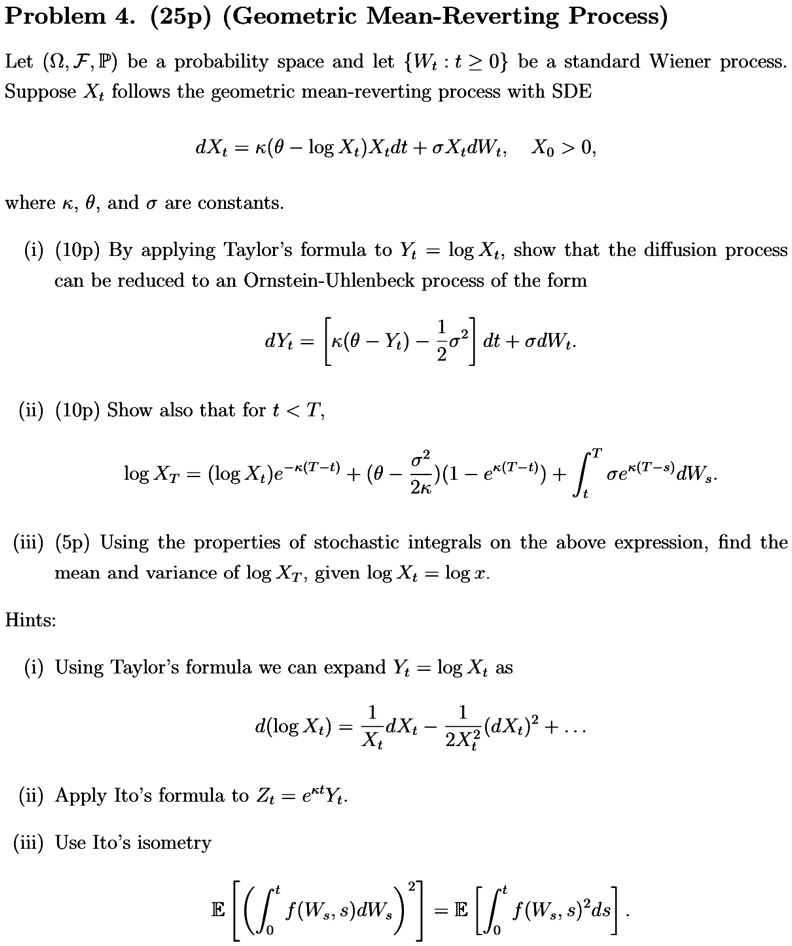
Problem 4. (25p) (Geometric Mean-Reverting Process)
Let (Omega ,F,P) be a probability space and let {W_(t):t>=0} be a standard Wiener process. Suppose x_(t) follows the geometric mean-reverting process with SDE
dx_(t)=kappa ( heta -logx_(t))x_(t)dt+sigma x_(t)dW_(t),x_(0)>0,
where kappa , heta , and sigma are constants.
(i) (10p) By applying Taylor's formula to Y_(t)=logx_(t), show that the diffusion process can be reduced to an Ornstein-Uhlenbeck process of the form
dY_(t)=[kappa ( heta -Y_(t))-(1)/(2)sigma ^(2)]dt+sigma dW_(t).
(ii) (10p) Show also that for logx_(T)=(logx_(t))e^(-kappa (T-t))+( heta -(sigma ^(2))/(2kappa ))(1-e^(kappa (T-t)))+int_t^T sigma e^(kappa (T-s))dW_(s).logx_(T)logx_(t)=logxY_(t)=logx_(t)d(logx_(t))=(1)/(x_(t))dx_(t)-(1)/(2x_(t)^(2))(dx_(t))^(2)+dotsZ_(t)=e^(kappa t)Y_(t)E[(int_0^t f(W_(s),s)dW_(s))^(2)]=E[int_0^t f(W_(s),s)^(2)ds].t,
logx_(T)=(logx_(t))e^(-kappa (T-t))+( heta -(sigma ^(2))/(2kappa ))(1-e^(kappa (T-t)))+int_t^T sigma e^(kappa (T-s))dW_(s).
(iii) (5p) Using the properties of stochastic integrals on the above expression, find the mean and variance of logx_(T), given logx_(t)=logx.
Hints:
(i) Using Taylor's formula we can expand Y_(t)=logx_(t) as
d(logx_(t))=(1)/(x_(t))dx_(t)-(1)/(2x_(t)^(2))(dx_(t))^(2)+dots
(ii) Apply Ito's formula to Z_(t)=e^(kappa t)Y_(t).
(iii) Use Ito's isometry
E[(int_0^t f(W_(s),s)dW_(s))^(2)]=E[int_0^t f(W_(s),s)^(2)ds].
Problem 4. (25p) (Geometric Mean-Reverting Process)
Let (,F,P) be a probability space and let {Wt:t > 0} be a standard Wiener process Suppose X, follows the geometric mean-reverting process with SDE
dX,=k(0-log X)X,dt+oX,dWtXo>0,
where K,,and are constants.
(i) (10p) By applying Taylor's formula to Y = log Xt, show that the diffusion process
can be reduced to an Ornstein-Uhlenbeck process of the form
Mpo+p
(ii) (10p) Show also that for t < T.
log XT =(log X)e-x(T-t) +
(iii) (5p) Using the properties of stochastic integrals on the above expression, find the
mean and variance of log XT, given log X, = log x.
Hints:
(i) Using Taylor's formula we can expand Y = log X, as
(ii) Apply Ito's formula to Zt = etY
(iii) Use Ito's isometry
f(Ws,s)dW