Questions asked
According to the rules of the United Nations, how can decisions be made? O By compromise O By agreement among the Security Council O By consensus O By majority rule
Which organ secretes enzymes that digest carbohydrates, proteins, and lipids? Select one: OA. Small Intestine OB. Pancreas OC. Stomach OD. Liver OE. Gallbladder
Clinical Connection Diabetes is a disease characterized by an inability to regulate blood glucose concentration as normal. In type 1 diabetes, insulin secretion is abnormally low. In type 2 diabetes, target cells for insulin respond poorly to insulin. Answer the following questions based on your understanding of insulin’s role in the regulation of blood glucose and the principles of chemical signaling: 1. Describe the kind of anatomic abnormality that would cause type 1 diabetes. 2. Describe the two basic kinds of anatomic abnormalities that would cause type 2 diabetes (hint: consider factors that influence the strength of target cells’ response to chemical signals). 3. Immediately following a meal, how would blood glucose concentration in an untreated diabetic compare to that of a non-diabetic? Explain your answer. 3
Malfunctions of regulation of the cell cycle can lead to uncontrolled tissue growth called Blank______. Multiple choice question. apoptosis neoplasia hypertrophy hyperplasia
Question 15 (3 points) A tournament increases the amount of risk from the external environment. a) True b) False
1) A point P(x, y) is given in rectangular coordinates, P( - \sqrt{2}, \sqrt{6}) a) Find polar coordinates for P with r ? 0. b) Find polar coordinates for P with r ? 0.
37. Understand how fatty acyl CoA is shuttled from the cytosol of the cell to the mitochondrial membrane •through \beta-oxidation
Shamrock Company's December 31, 2022, trial balance includes the following accounts: Inventory $153,600, Buildings $264,960, Accumulated Depreciation-Equipment $24,320, Equipment $243,200, Land Held for Investment $58,880, Accumulated Depreciation-Buildings $57,600, Land $90,880. Prepare the property, plant, and equipment section of the statement of financial position. (List Property, Plant and Equipment in order of Land, Buildings and Equipment. Enter account name only and do not provide the descriptive information provided in the question.) SHAMROCK COMPANY Statement of Financial Position (Partial) v: $ $ $
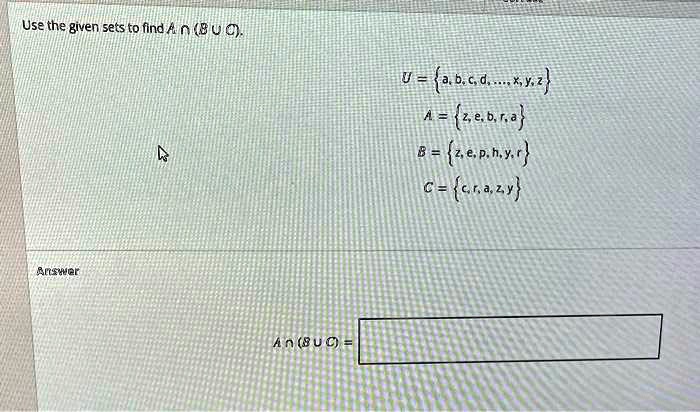
Use the given sets to find $A \cap (B \cup C)$. \\ $U = \{a, b, c, d, ..., x, y, z\}$\\ $A = \{z, e, b, r, a\}$\\ $B = \{z, e, p, h, y, r\}$\\ $C = \{c, r, a, z, y\}$\\ Answer \\ $A \cap (B \cup C) = $
(a) Consider a silicon sample at $T = 300 K$ doped with $10^{16} cm^{-3}$ donor atoms. Let \$\tau_{p0} = 5 \times 10^{-7} s$. A light source turns on at $t = 0$ producing excess carriers with a \$\text{uniform generation rate of } g' = 5 \times 10^{20} cm^{-3} s^{-1}$. At $t = 5 \times 10^{-7} s$, the light source \$\text{turns off. (i) Derive the expression(s) for the excess carrier concentration as a function} \$\text{of time over the range } 0 \le t \le \infty. (ii) What is the value of the excess concentration} \$\text{when the light source turns off. (b) Repeat part (a) for the case when the light source} \$\text{turns off at } t = 2 \times 10^{-6} s. (c) Sketch the excess minority carrier concentrations \$\text{versus time for parts (a) and (b).