In class we derived the dispersion relation for electron waves by assuming that
the ions did not respond to the wave (infinite mass approximation) and that
electron perturbation would generate density, velocity, and field perturbations.
Using Poisson equation and the electron fluid continuity and momentum equa-
tions, we were able to derive the dispersion relation for electron waves in a
plasma. This is valid for frequencies where the electrons can respond but the
ions are too fat and slow to respond.
For this homework, the plasma response to lower frequencies where the ions
CAN respond will be studied. In this regime, we are going to assume that the
ion response to perturbations is governed by the ion fluid equations, but that
the electrons have \"zero mass\", effectively we are going to assume that the
electrons INSTANTANEOUSLY respond to forces, specifically electrostatic po-
tentials through the Boltzmann Relation.
This changes things a little, since the instantaneous response of the electrons
eliminates the formation of volume density $\rho$, and that means we cannot use
Poisson's equation.
1. For this problem we set up the linearized fluid momentum equation for
ions assuming a plane wave perturbation
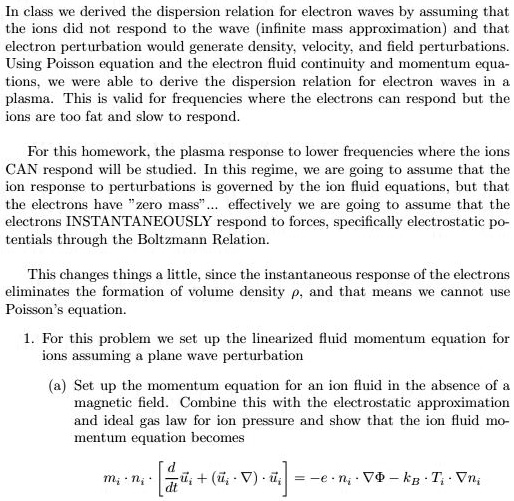
(a) Set up the momentum equation for an ion fluid in the absence of a
magnetic field. Combine this with the electrostatic approximation
and ideal gas law for ion pressure and show that the ion fluid mo-
mentum equation becomes
$m_i n_i \left[ \frac{d \vec{u}_i}{dt} + (\vec{u}_i \cdot \nabla) \vec{u}_i \right] = -e n_i \nabla \Phi - k_B T_i \nabla n_i$