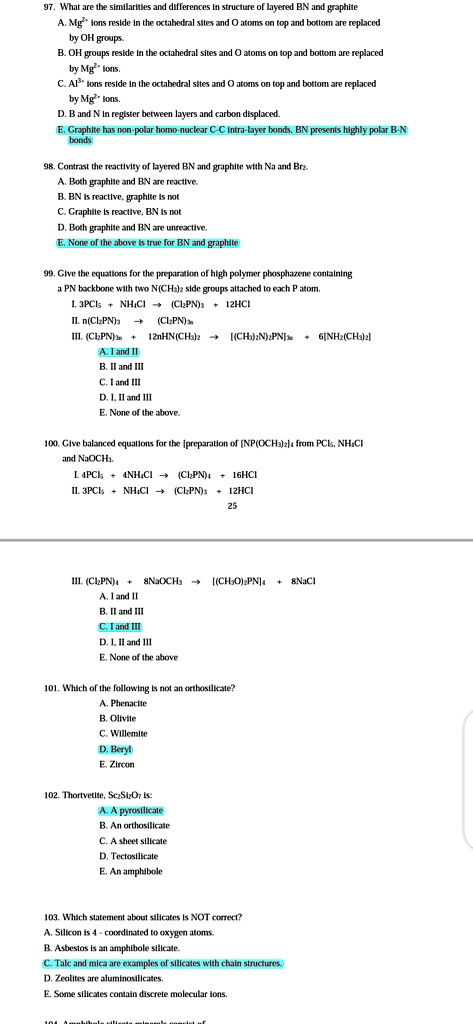
97. What are the similarities and differences in the structure of layered BN and graphite? Mg^(2+) ions reside in the octahedral sites and O atoms on top and bottom are replaced by OH groups. B. OH groups reside in the octahedral sites and O atoms on top and bottom are replaced by Mg^(3+) ions. C. Al^(3+) ions reside in the octahedral sites and O atoms on top and bottom are replaced by Mg^(2+) ions. D. B and N in register between layers and carbon displaced. E. Graphite has non-polar homo-nuclear C-C intra-layer bonds, BN presents highly polar B-N bonds.
98. Contrast the reactivity of layered BN and graphite with Na and Br2. A. Both graphite and BN are reactive. B. BN is reactive, graphite is not. C. Graphite is reactive, BN is not. D. Both graphite and BN are unreactive. E. None of the above is true for BN and graphite.
99. Give the equations for the preparation of high polymer phosphazene containing a PN backbone with two N(CH3)2 side groups attached to each P atom. I. 3PCl5 + NH4Cl -> (Cl2PN)3 + 12HCl II. n(Cl2PN)3 -> (Cl2PN)3n III. (Cl2PN)3n + 12nHN(CH3)2 -> [(CH3)2(N))2PN. A. I and II B. II and III C. I and III D. I, II, and III E. None of the above.
100. Give balanced equations for the preparation of [NP(OCH3)2]4 from PCl5, NH4Cl, and NaOCH3. I. 4PCl5 + 4NH4Cl -> (Cl2PN)4 + 16HCl II. 3PCl5 + NH4Cl -> (Cl2PN)3 + 12HCl III. (Cl2PN)4 + 8NaOCH3 -> [(CH3O)2PN]4 + 8NaCl. A. I and II B. II and III C. I and III D. I, II, and III E. None of the above.
101. Which of the following is not an orthosilicate? A. Phenacite B. Olivite C. Willemite D. Beryl E. Zircon.
102. Thortvetite, Sc2Si2O7 is: A. A pyrosilicate B. An orthosilicate C. A sheet silicate D. Tectosilicate E. An amphibole.
103. Which statement about silicates is NOT correct? A. Silicon is 4-coordinated to oxygen atoms. B. Asbestos is an amphibole silicate. C. Talc and mica are examples of silicates with chain structures. D. Zeolites are aluminosilicates. E. Some silicates contain discrete molecular ions.