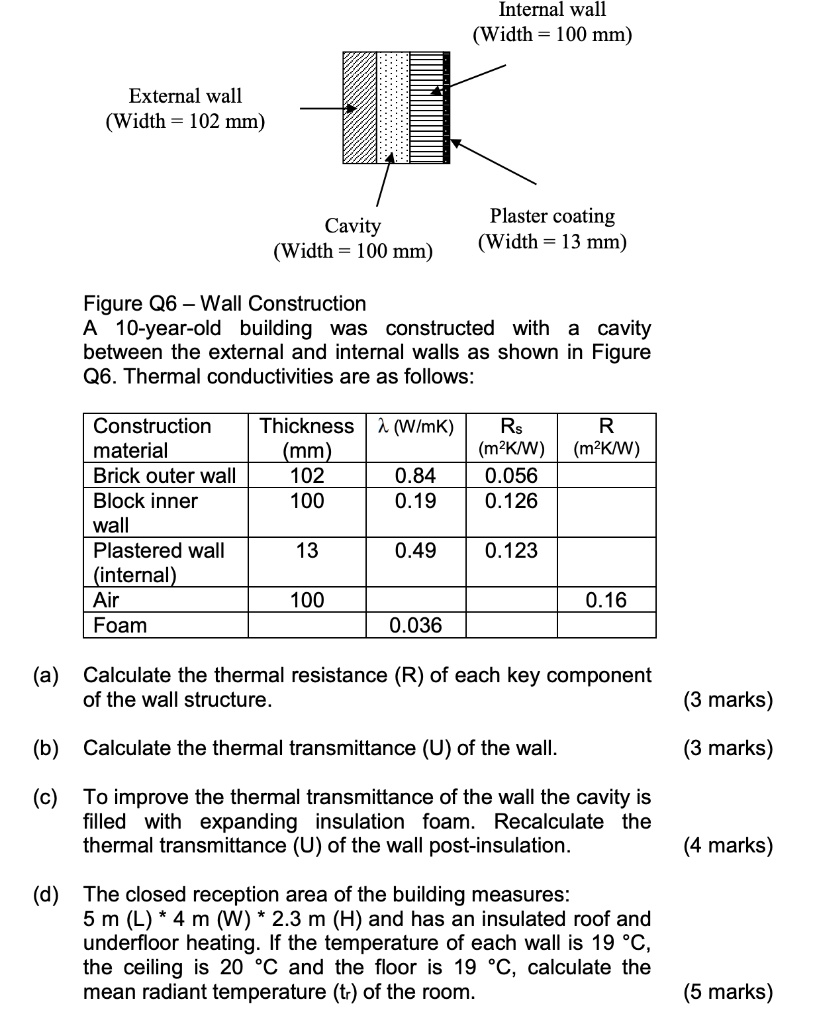
Text: Internal wall
(Width = 100 mm)
External wall (Width = 102 mm)
Plaster coating (Width = 13 mm)
Cavity
(Width = 100 mm)
Figure Q6 -- Wall Construction A 10-year-old building was constructed with a cavity between the external and internal walls as shown in Figure Q6. Thermal conductivities are as follows:
Construction material Brick outer wall Block inner wall Plastered wall (internal) Air Foam
Thickness (mm) Thermal conductivity (W/mK) Thermal resistance (m2K/W)
102 0.84 0.056
100 0.19 0.126
13 0.49 0.123
100 0.16 0.036
(a) Calculate the thermal resistance (R) of each key component of the wall structure.
(3 marks)
(b) Calculate the thermal transmittance (U) of the wall.
(3 marks)
(c) To improve the thermal transmittance of the wall, the cavity is filled with expanding insulation foam. Recalculate the thermal transmittance (U) of the wall post-insulation.
(4 marks)
(d) The closed reception area of the building measures 5 m (L) * 4 m (W) * 2.3 m (H) and has an insulated roof and underfloor heating. If the temperature of each wall is 19 °C, the ceiling is 20 °C, and the floor is 19 °C, calculate the mean radiant temperature (tr) of the room.
(5 marks)