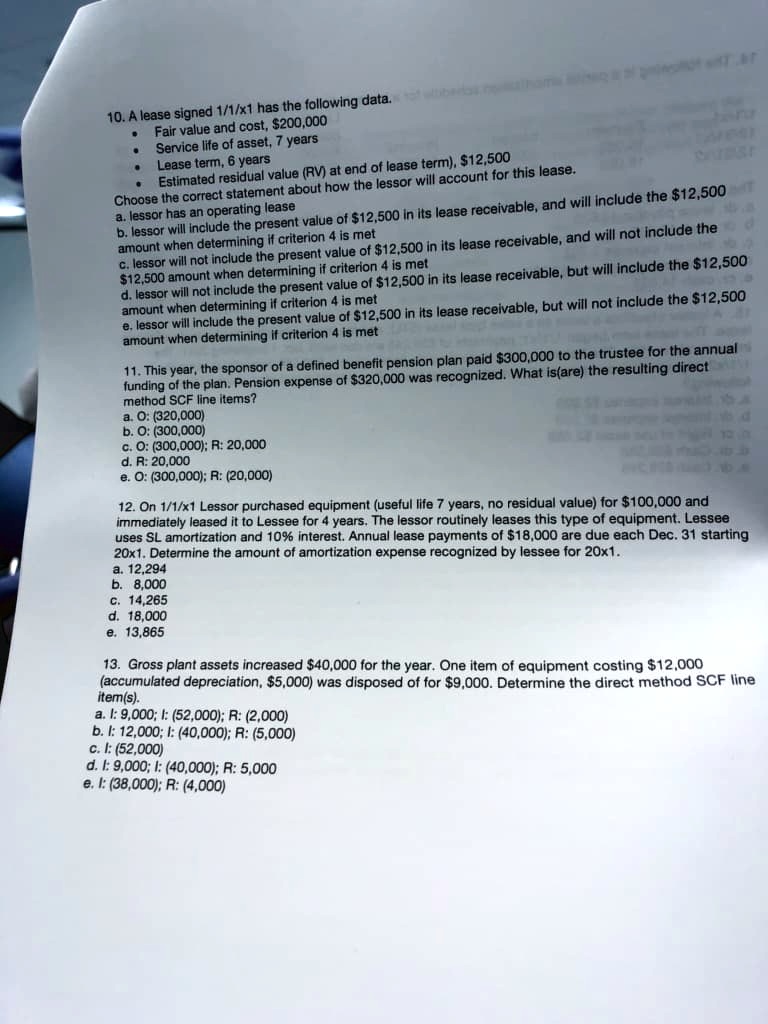
10. A lease signed 1/1/x1 has the following data:
- Fair value and cost, $200,000
- Service life of asset, 7 years
- Lease term, 6 years
- Estimated residual value (RV at end of lease term), $12,500
Choose the correct statement about how the lessor will account for this lease.
a. The lessor has an operating lease.
b. The lessor will not include the present value of $12,500 in its lease receivable and will not include the amount when determining if criterion 4 is met.
c. The lessor will not include the present value of $12,500 in its lease receivable but will include the $12,500 amount when determining if criterion 4 is met.
d. The lessor will include the present value of $12,500 in its lease receivable but will not include the $12,500 amount when determining if criterion 4 is met.
11. This year, the sponsor of a defined benefit pension plan paid $300,000 to the trustee for the annual funding of the plan. Pension expense of $320,000 was recognized. What is (are) the resulting direct method SCF line items?
a. O(320,000)
b. O:(300,000)
c. O(300,000)R20,000
d. R20,000
e. O:300,000R(20,000)
12. On 1/1/x1, the lessor purchased equipment (useful life 7 years, no residual value) for $100,000 and immediately leased it to the lessee for 4 years. The lessor routinely leases this type of equipment. The lessee uses SL amortization and 10% interest. Annual lease payments of $18,000 are due each Dec. 31 starting 20x1. Determine the amount of amortization expense recognized by the lessee for 20x1.
a. 12,294
b. 8,000
c. 14,265
d. 18,000
e. 13,865
13. Gross plant assets increased $40,000 for the year. One item of equipment costing $12,000 (accumulated depreciation, $5,000) was disposed of for $9,000. Determine the direct method SCF line item(s).
a. I:9,000; I:52,000R2,000
b. I:12,000; I:40,000R5,000
c. I(52,000)
d. 9,000; I:40,000R5,000
e. I38,000)R4,000