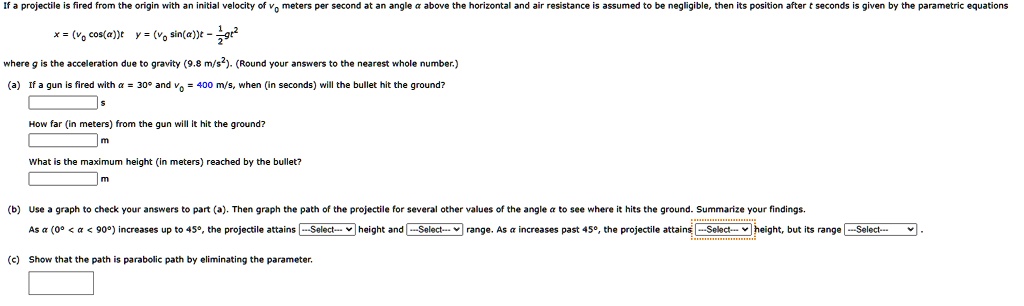
x = v₀cos(α)t, y = v₀sin(α)t - (1/2)gt²
where g is the acceleration due to gravity (9.8 m/s²). (Round your answers to the nearest whole number.)
(a) If a gun is fired with α = 30° and v₀ = 400 m/s, when (in seconds) will the bullet hit the ground?
s
How far (in meters) from the gun will it hit the ground?
m
What is the maximum height (in meters) reached by the bullet?
m
As α (0° < α < 90°) increases up to 45°, the projectile attains -- Select-- vv height and -- Select-- vv range. As α increases past 45°, the projectile attains
height, but its range -- Select-- vv.
(c) Show that the path is a parabolic path by eliminating the parameter.
If a projectile is fired from the origin
x = v₀gcosy = v₀sinae = g
where g is the acceleration due to gravity (9.8 m/s²). (Round your answers to the nearest whole number.)
(a) If a gun is fired with α = 30° and v₀ = 400 m/s, when (in seconds) will the bullet hit the ground?
s
How far (in meters) from the gun will it hit the ground? m
What is the maximum height (in meters) reached by the bullet? m
(b) Use a graph to check your answers to part (a). Then graph the path of the projectile for several other values of the angle α to see where it hits the ground. Summarize your findings
As (0<< 90) increases up to 45, the projectile attains--Select--- height and-Select---range. As increases past 45, the projectile attains--Select---vheight, but its range[--Select---
(c) Show that the path is a parabolic path by eliminating the parameter.