Ace - AI Tutor
Ask Our Educators
Textbooks
My Library
Flashcards
Scribe - AI Notes
Notes & Exams
Download App
jessica butler

jessica b.

Divider

Questions asked

BEST MATCH

Pick the substance with the lowest freezing point: N_(2),CO, or CO_(2)

View Answer
divider
BEST MATCH

What is the mean and degrees of freedom (n-1) of the following dataset containing measurements of finch beak depths? Finch beak depths 10.2 8.5 9.5 10.6 9.1 7.3 mean = 9.2, df = 6 Omean = 55.2, df = 6 Omean = 9.2, df = 5 Omean = 11.04, df = 5

View Answer
divider
BEST MATCH

(DNA structure/Function) A point mutation in DNA that changes a codon in the mRNA and causes an amino acid substitution that does not alter the function of the final protein product is termed a neutral mutation framsehift mutation missense mutation nonsense mutation

View Answer
divider
BEST MATCH

Vulnavia is 7 months old and has begun to engage in the concepts of object permanence. Her mother feels she should have totally grasped the concept of object permanence and is concerned her daughter may have developmental delays. What should a developmental specialist correctly tell Vulnavia's mother regarding this concept? Group of answer choices In a child's mind, unanticipated events are treated as interesting, and also as something to be explained and understood. Imitation is a huge factor related to this concept, so Vulnavia's mother needs to enact more vivid examples of object permanence. It takes several months for the concept to be fully comprehended, and Vulnavia will make certain kinds of errors along the way. Vulnavia has jumped ahead of this developmental marker.

View Answer
divider
BEST MATCH

What did the transitional form between fish and land animals with legs look like? What is the name of this organism? What selective pressure likely gave rise to this organism?

View Answer
divider
BEST MATCH

From every linear mapping from to , there is an associated matrix. Match the following linear mappings with their associated standard matrix. C 1. The projection onto the -axis given by . D 2. Counter-clockwise rotation by radians. B 3. Reflection about the -axis. F 4. Reflection about the line . A 5. Reflection about the -axis. E 6. Clockwise rotation by radians. A. B. C. D. E. F. G. None of the above Note: If the answer is A., type A in the answer box, etc. (i.e. ignore the period '.' in A.). You are only given two attempts for this problem. Note: You can earn partial credit on this problem.

View Answer
divider
BEST MATCH

Question 2 [10 marks] A soldier in a helicopter hovering at a height of 200 m fires his carbine at a ground target directly below him. The bullet (mass $m$) is discharged at a speed of 400 $ms^{-1}$. It ex- periences atmospheric drag proportional to the square of its speed with a proportionality constant $\beta m$, where $\beta = 0.001 m^{-1}$. Integrate Newton's second law of motion once in order to find the relationship between the speed of the bullet and its position and then use this relationship to calculate the speed at which the bullet hits the target. $\frac{dv}{dt} = \frac{dv}{dr} \frac{dr}{dt} = \frac{dv}{dr} v$

View Answer
divider
BEST MATCH

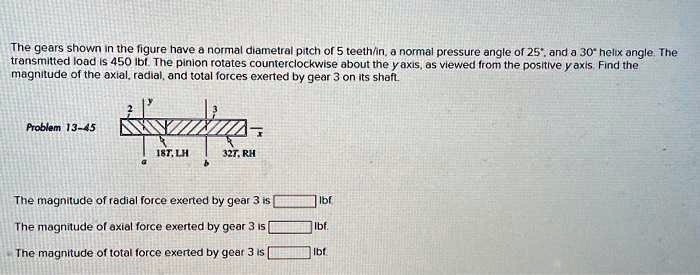
The gears shown in the figure have a normal diametral pitch of 5 teeth/in, a normal pressure angle of 25°, and a 30° helix angle. The transmitted load is 450 lbf. The pinion rotates counterclockwise about the y axis, as viewed from the positive y axis. Find the magnitude of the axial, radial, and total forces exerted by gear 3 on its shaft. Problem 13-45 187, LH 327, RH The magnitude of radial force exerted by gear 3 is ____ lbf The magnitude of axial force exerted by gear 3 is ____ lbf The magnitude of total force exerted by gear 3 is ____ lbf
View Answer
divider
BEST MATCH

Place the following solutions in order of decreasing osmotic pressure: I. 0.15 M C2H6O2, II. 0.15 M SrCl2, III. 0.15 M NaF. III < I < II II < III < I I < II < III II < I < III

View Answer
divider
BEST MATCH

Prove the theorem: The solutions in non-negative integers of the equation x^2 + 2y^2 = z^2 with gcd(x, y, z) = 1 are given by x = ±(2x^2 - t^2), y = 2st, z = 2s^2 + t^2, where s and t are arbitrary non-negative integers.

View Answer
divider