Questions asked
Which of the following is not essential for the polymerase chain reaction? ? Dideoxynucleotides ? DNA template ? Deoxynucleotides ? Oligonucleotide primers ? Taq DNA polymerase
Which of the following correctly describe facultative anaerobes? They can grow without $O_2$. Their growth is faster when $O_2$ is available. They can only grow in the absence of $O_2$. They can grow in the presence of $O_2$ but do not use it to harvest energy.
Problem 8 Give a formal proof of the following theorem. PS4.8 T \vdash (A \leftrightarrow B) \leftrightarrow ((A \to B) \land \neg (B \land \neg A))
7. Consider the truthfulness of the following statement: "The inverse elasticity rule implies a monopoly firm can set any price it wants as long demand elasticity is below -1." a. True b. False
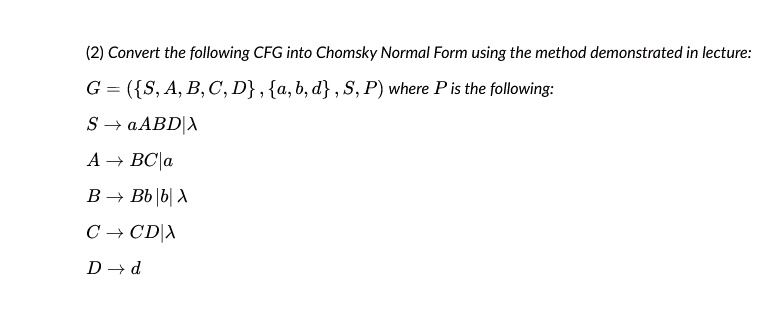
(2) Convert the following CFG into Chomsky Normal Form using the method demonstrated in lecture: G = ({S, A, B, C, D}, {a, b, d}, S, P) where P is the following: S ? aABD|? A ? BC|a B ? Bb|b|? C ? CD|? D ? d
Lab Section: Name: LAB 2 PRELAB QUESTIONS Water Hardness Instructions: Complete the following questions and hand in at the start of your lab period or when instructed by your instructor. Show your work with units and correct significant figures for all questions that involve a calculation. Circle your numerical answers. NOTE: You may never use the dilution equation in place of stoichiometry for a reaction. 1) A 10.00 mL aliquot of 0.010 M CaCO$_3$ is titrated with 18.22 mL of EDTA solution. What is the EDTA molarity? 2) A 100.0 ml water sample required 15.00 mL of EDTA solution during trial 1. What would be an appropriate volume to use during trial 2? (Note: You must read the full lab document to know how to answer this question, as it is always assumed that you answer these in the context of the lab being performed. This means you should have already read the whole lab document and written out your lab procedure before starting these prelab questions.) 3) A 250.0 ml water sample requires 30.85 mL of the EDTA solution from question 1 to reach the calmagite endpoint. What was the molarity of the hard metal ions in the water sample? 4) If the metal ions in the water sample of question 2 are assumed to be Ca$^{2+}$ from CaCO$_3$, express the concentration in ppm CaCO$_3$. This is the same as the concentration in units of mg CaCO$_3$ per liter of sample.
Write a C++ program that will print the following triangle of numbers in a function. (Please use a function to print it) 1 1 2 1 2 3 1 2 3 4 1 2 3 4 5 1 2 3 4 5 6 1 2 3 4 5 6 7 1 2 3 4 5 6 7 8 1 2 3 4 5 6 7 8 9
Question 14 Vacuum fixturing creates strong hold down forces to eliminate all clamping perpendicular to the part. True False
4. The frequency distribution technique: a. Searches sequentially through a table to find the matching values and then counts them. b. Uses an input value to count the number of equivalent values. c. Uses the value of an element of one array as the element number of another array and then increments the value found in that element number. d. Uses a cross tabulation method of counting the frequency of numbers.
4. Air leaves the subsonic diffuser of a ramjet engine with a static pressure of 0.5516 x 10$^5$ Pa. Between the diffuser exit and the combustion chamber inlet sections, a liquid fuel is sprayed into the air. The fuel is vaporised and thoroughly mixed with the air and enters a constant-area combustion chamber with a static temperature of 333 K and an average velocity of 73.15 m/s. The energy of combustion for each unit mass of the air-fuel mixture is 1396 kJ/kg. Assume that the working fluid has the same thermodynamic properties as air before and after combustion, and that friction is negligible. Calculate: (a) The stagnation temperature after combustion. (b) The Mach number after combustion. (c) The final static temperature. (d) The loss in stagnation pressure due to heat addition. (e) The entropy change. Take the gas constant, the isentropic index and the specific heat at constant pressure of air as 287 J/kgK, 1.4 and 1.005 kJ/kgK respectively. (6 marks) (5 marks) (2 marks) (5 marks) (2 marks)