Please help.
Explain what is going on between each step, how the derivation begins, and add possible additional drawings where appropriate.
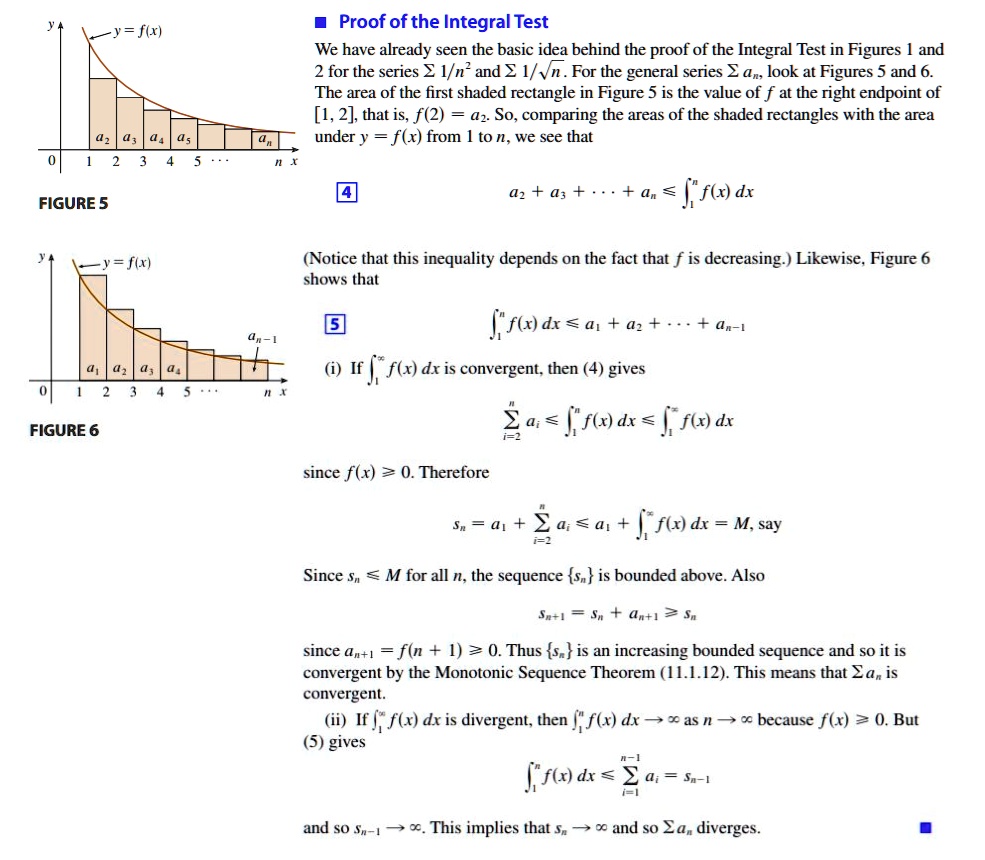
Proof of the Integral Test We have already seen the basic idea behind the proof of the Integral Test in Figures 1 and 2 for the series 1/n3 and 1/n . For the general series an, look at Figures 5 and 6. The area of the first shaded rectangle in Figure 5 is the value of f at the right endpoint of [1, 2], that is, f(2) = 2. So, comparing the areas of the shaded rectangles with the area under y= fxfrom 1 to n,we see that
=fx
a
a
0
1
2
3
4
5
[4
a+a+...+a,("f(x)dx
FIGURE 5
=fx
(Notice that this inequality depends on the fact that f is decreasing. Likewise, Figure 6 shows that
[5
fxdx<a+a+...+an-1
a
(iIf fx dx is convergent, then (4) gives
0
1
2
3
affxdxffxdx
FIGURE6
since fx>0.Therefore
s=a+Laa+fxdx=M,say
Since snM for all n,the sequence{s.} is bounded above.Also
Sn+1=Sn+an+1S
since an+i=fn+1>0.Thus{s.}is an increasing bounded sequence and so it is convergent by the Monotonic Sequence Theorem (11.1.12.This means that a, is convergent.
(5gives
f(xdxa=sn-1
and so sn--This implies that s and soadiverges