a) Compute the molarity of pure water. That is, how many moles of water are in a liter of water? Density of water is 1.0 g/ml.
b) Kw is a constant at 25°C, but it increases with temperature. Use the following values of Kw to compute the pH of pure water at the stated temperatures. (Hint: for pure water [OH^-]=[H3O^+])
i. What is the pH at 0°C given that Kw=0.114 x 10^-14 M^2?
ii. What is the pH at 100°C given that Kw=51.3 x 10^-14 M^2?
d) Based on the effect of temperature on Kw, how does the addition of heat shift the equilibrium for the autoionization reaction:
H2O + H2O <==> [OH^-] + [H3O^+]
Does heat shift the equilibrium toward reactants or products? Does the reaction release heat or absorb heat? Explain.
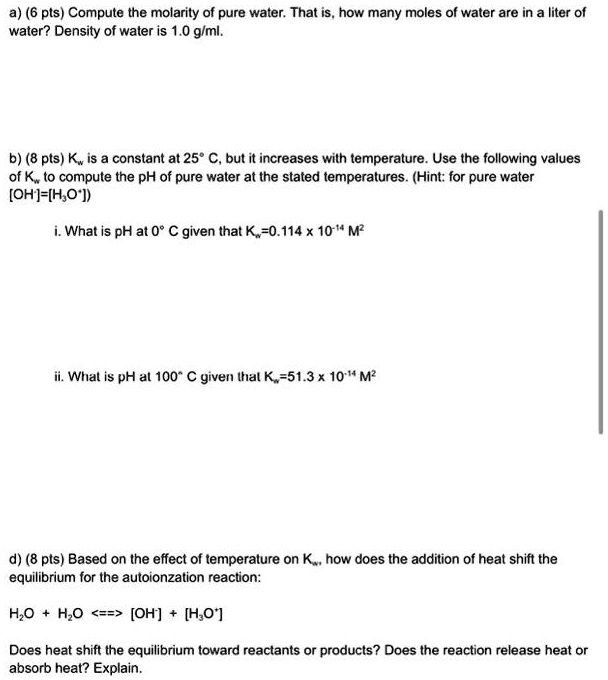
a) (6 pts) Compute the molarity of pure water. That is, how many moles of water are in a liter of water? Density of water is 1.0 g/ml.
b) (8 pts) Kw is a constant at 25°C, but it increases with temperature. Use the following values of Kw to compute the pH of pure water at the stated temperatures. (Hint: for pure water [OH^-]=[H3O^+])
i. What is the pH at 0°C given that Kw=0.114 x 10^-14 M^2?
ii. What is the pH at 100°C given that Kw=51.3 x 10^-14 M^2?
d) (8 pts) Based on the effect of temperature on Kw, how does the addition of heat shift the equilibrium for the autoionization reaction:
H2O + H2O <==> [OH^-] + [H3O^+]
Does heat shift the equilibrium toward reactants or products? Does the reaction release heat or absorb heat? Explain.