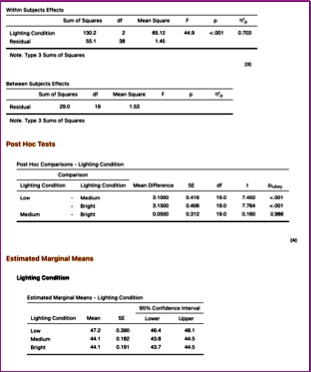
Texts: Dr. Eyeball wants to understand how well people can read under different lighting conditions. To do this, she recruits a group of 20 people to come to her lab and read different short paragraphs— each under a different lighting condition (low, medium, and bright light). All participants experience all 3 lighting conditions. Dr. Eyeball then records the amount of time (in seconds) it takes each participant to read each paragraph. Her results comparing the reading times are below.
Dr. Eyeball conducted an analysis of variance (ANOVA) to examine the effects of lighting condition on reading time. The independent variable was the lighting condition (low, medium, and bright light), and the dependent variable was the time it took to read each paragraph. The ANOVA revealed a significant effect of lighting condition on reading time, F(2, 57) = 130.2, p < .001, η² = .79.
To further investigate the significant effect, Dr. Eyeball conducted three Tukey post hoc tests. The first test compared reading times between low and medium lighting conditions, revealing a significant difference, t(57) = 3.1996, p = .006, d = 0.6416. The second test compared reading times between low and bright lighting conditions, also revealing a significant difference, t(57) = 7.656, p < .001, d = 1.53. The third test compared reading times between medium and bright lighting conditions, again revealing a significant difference, t(57) = 7.76, p < .001, d = 1.53.
In conclusion, the results indicate that lighting condition significantly affects reading time. Participants took significantly longer to read under low lighting conditions compared to both medium lighting conditions (M = 46.1 seconds, p = .006, d = 0.6416) and bright lighting conditions (M = 46.1 seconds, p < .001, d = 1.53). Additionally, participants took significantly longer to read under medium lighting conditions compared to bright lighting conditions (M = 46.5 seconds, p < .001, d = 1.53).