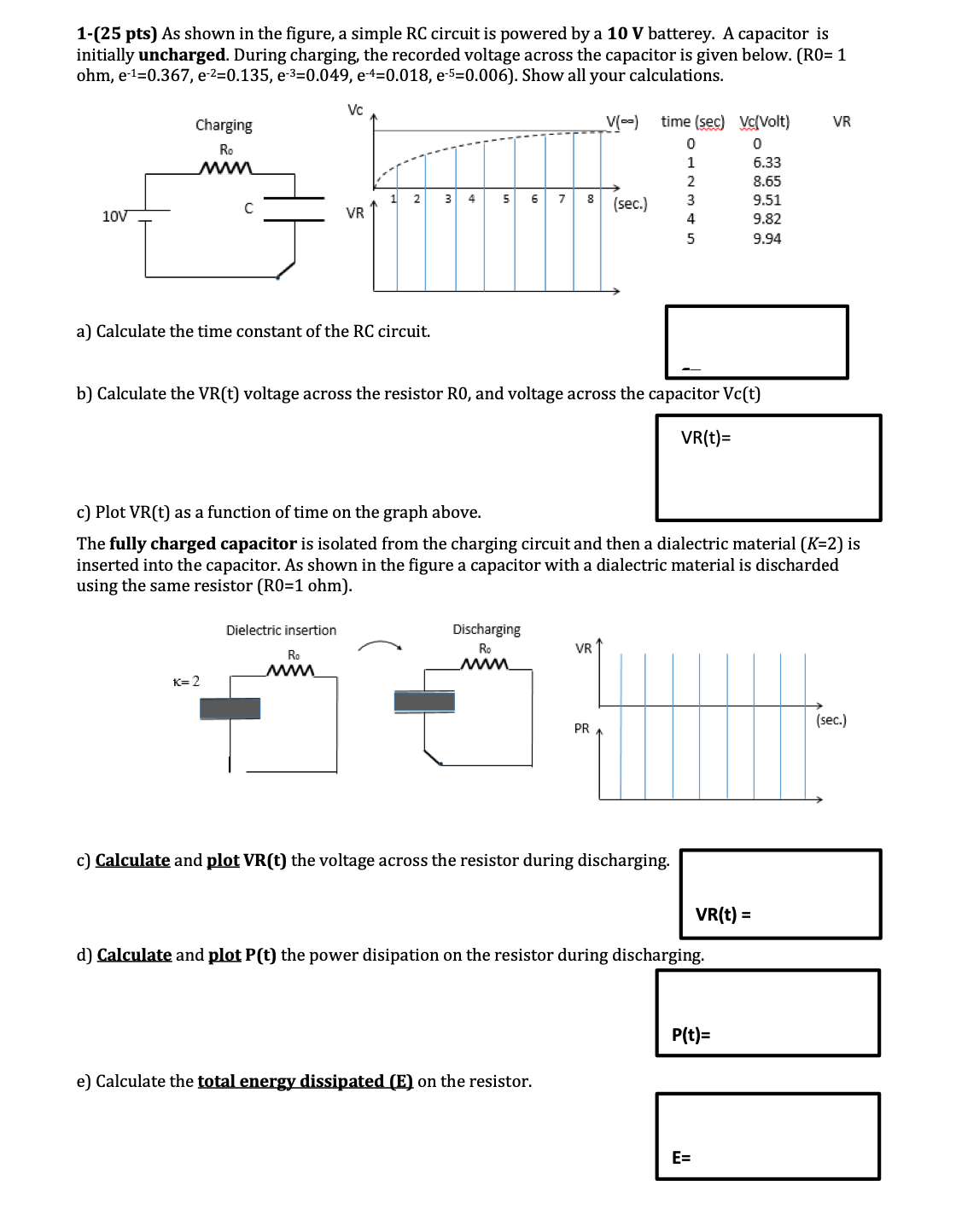
1-(25 pts) As shown in the figure, a simple RC circuit is powered by a \( 10 \mathrm{~V} \) batterey. A capacitor is initially uncharged. During charging, the recorded voltage across the capacitor is given below. ( \( \mathrm{R} 0=1 \) ohm, \( \mathrm{e}^{-1}=0.367, \mathrm{e}^{-2}=0.135, \mathrm{e}^{-3}=0.049, \mathrm{e}^{-4}=0.018, \mathrm{e}^{-5}=0.006 \) ). Show all your calculations.
\begin{tabular}{ccc}
time (sec) & \( V_{c}( \) Volt) & \( V R \) \\
0 & 0 & \\
1 & 6.33 & \\
2 & 8.65 & \\
3 & 9.51 & \\
4 & 9.82 \\
5 & 9.94
\end{tabular}
a) Calculate the time constant of the RC circuit.
b) Calculate the VR(t) voltage across the resistor R0, and voltage across the capacitor \( \mathrm{Vc}(\mathrm{t}) \)
\[
V R(t)=
\]
c) Plot VR(t) as a function of time on the graph above.
The fully charged capacitor is isolated from the charging circuit and then a dialectric material \( (K=2) \) is inserted into the capacitor. As shown in the figure a capacitor with a dialectric material is discharded using the same resistor ( \( \mathrm{R} 0=1 \mathrm{ohm} \) ).
c) Calculate and plot VR(t) the voltage across the resistor during discharging.
\[
\operatorname{VR}(\mathrm{t})=
\]
d) Calculate and plot \( \mathbf{P}(\mathbf{t}) \) the power disipation on the resistor during discharging.
\[
\mathbf{P}(\mathbf{t})=
\]
e) Calculate the total energy dissipated (E) on the resistor.
\( E= \)