If the image with the question disappears, visit this link to view: http://answers.yahoo.com/question/index?qid=20131014204617AAyK5hs. I would appreciate it if work was shown and most parts answered (I probably won't give the best answer to just one or two parts). I can extend the time limit if it's running low. Thanks.
5. Firm Impacts of Environmental Regulation (with Implications for Technological Change)
Businesses often oppose environmental regulation because it raises their operating costs, reducing their profits. In fact, some firms may see their costs rise so much that they can no longer make a profit and go out of business.
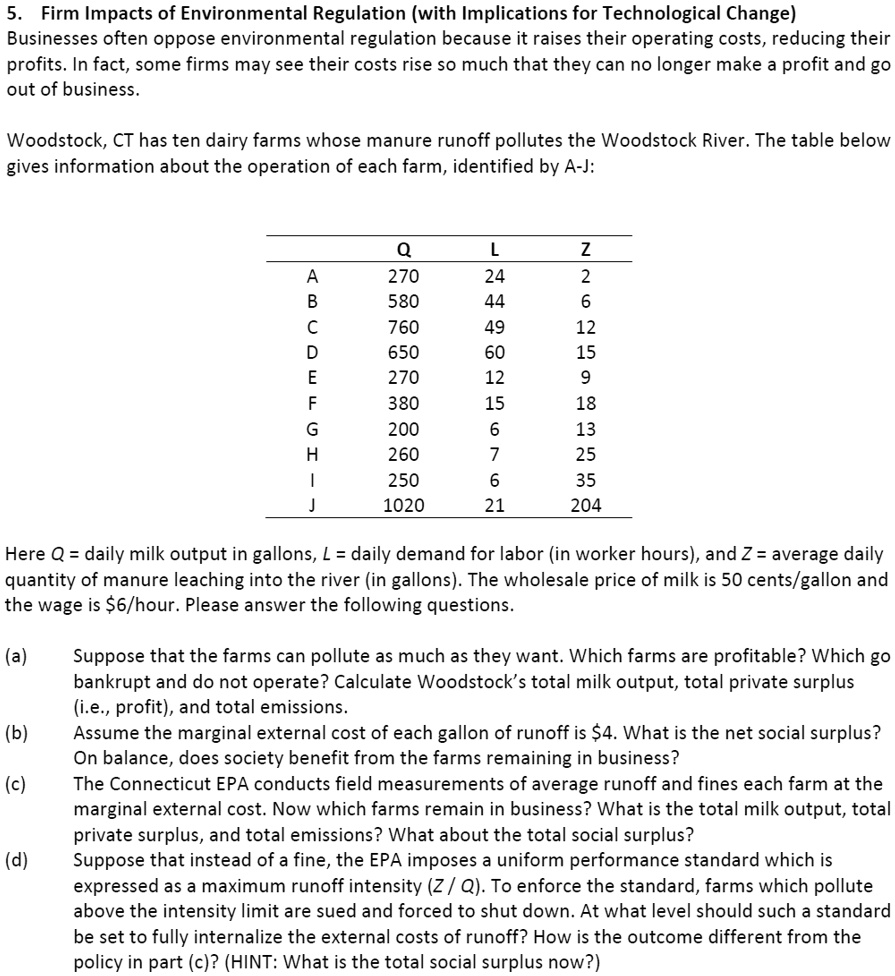
Woodstock, CT has ten dairy farms whose manure runoff pollutes the Woodstock River. The table below gives information about the operation of each farm, identified by A-J:
Q 270 580 760 650 270 380 200 260 250 1020
L 24 44 49 60 12 15 6 7 6 21
Z 2 6 12 15 9 18 13 25 35 204
A B C D E F G H I J
Here Q = daily milk output in gallons, L = daily demand for labor (in worker hours), and Z = average daily quantity of manure leaching into the river (in gallons). The wholesale price of milk is 50 cents/gallon and the wage is $6/hour. Please answer the following questions.
(a)
Suppose that the farms can pollute as much as they want. Which farms are profitable? Which go bankrupt and do not operate? Calculate Woodstock's total milk output, total private surplus (i.e., profit), and total emissions. Assume the marginal external cost of each gallon of runoff is $4. What is the net social surplus? On balance, does society benefit from the farms remaining in business? The Connecticut EPA conducts field measurements of average runoff and fines each farm at the marginal external cost. Now which farms remain in business? What is the total milk output, total private surplus, and total emissions? What about the total social surplus? Suppose that instead of a fine, the EPA imposes a uniform performance standard which is expressed as a maximum runoff intensity (Z/Q). To enforce the standard, farms that pollute above the intensity limit are sued and forced to shut down. At what level should such a standard be set to fully internalize the external costs of runoff? How is the outcome different from the policy in part (c)? (HINT: What is the total social surplus now?)
(b)
(c)
(d)