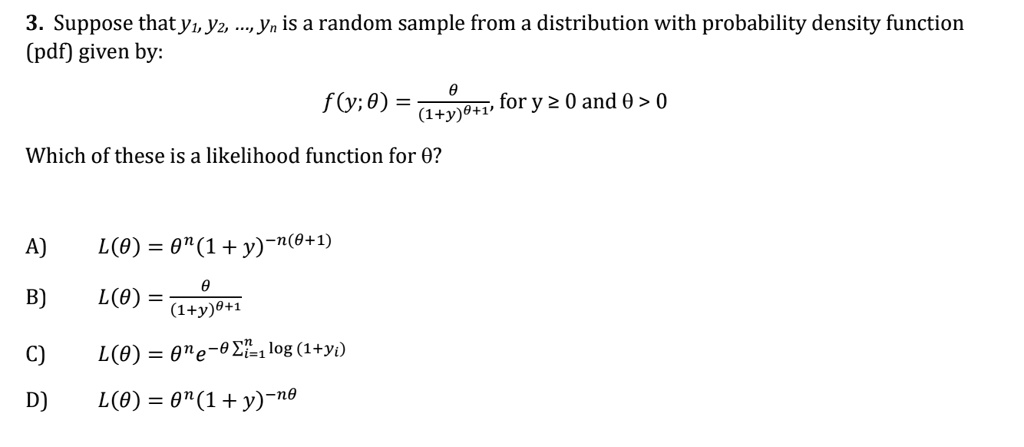
3. Suppose that $y_1, y_2, ..., y_n$ is a random sample from a distribution with probability density function
(pdf) given by:
$\theta$
f(y; $\theta$) = \frac{\theta}{(1+y)^{\theta+1}}$, for y ? 0 and $\theta$ > 0
Which of these is a likelihood function for $\theta$?
A)
L($\theta$) = $\theta^n$(1 + y)$^{-n(\theta+1)}$
$\theta$
B)
L($\theta$) = \frac{\theta}{(1+y)^{\theta+1}}
C)
L($\theta$) = $\theta^n e^{-\theta \sum_{i=1}^{n} log (1+y_i)}$
D)
L($\theta$) = $\theta^n$(1 + y)$^{-n\theta}$