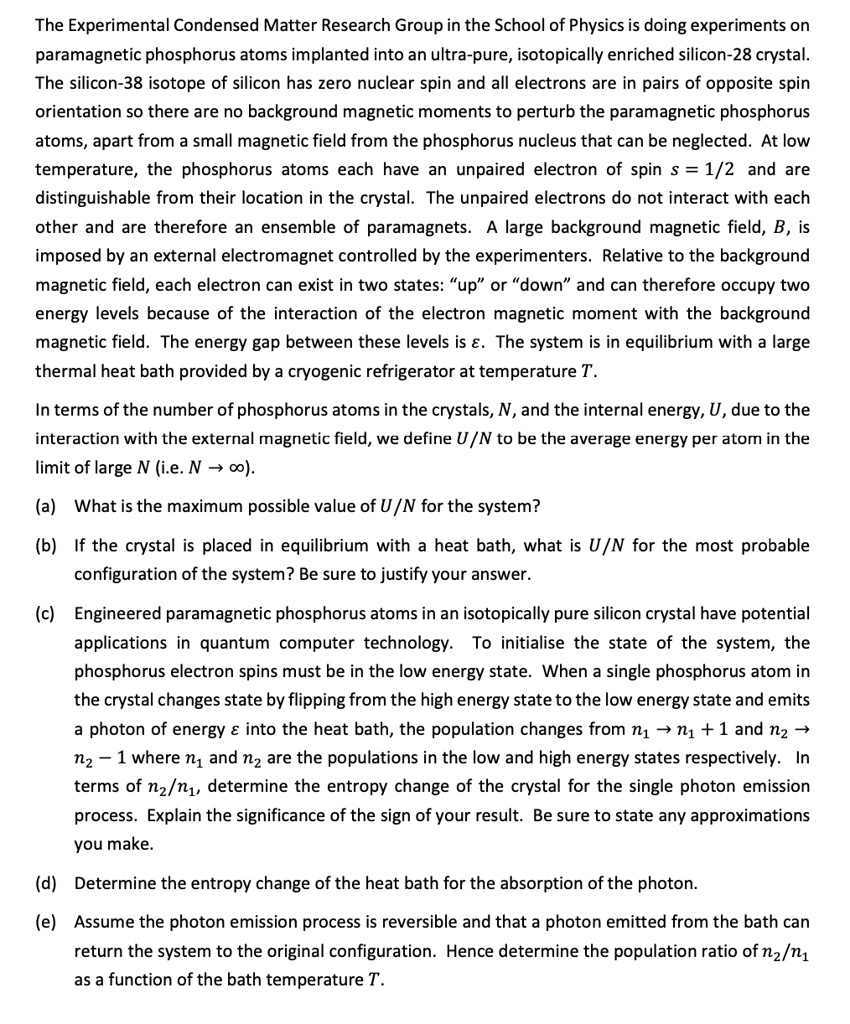
The Experimental Condensed Matter Research Group in the School of Physics is doing experiments on
paramagnetic phosphorus atoms implanted into an ultra-pure, isotopically enriched silicon-28 crystal.
The silicon-38 isotope of silicon has zero nuclear spin and all electrons are in pairs of opposite spin
orientation so there are no background magnetic moments to perturb the paramagnetic phosphorus
atoms, apart from a small magnetic field from the phosphorus nucleus that can be neglected. At low
temperature, the phosphorus atoms each have an unpaired electron of spin s = 1/2 and are
distinguishable from their location in the crystal. The unpaired electrons do not interact with each
other and are therefore an ensemble of paramagnets. A large background magnetic field, B, is
imposed by an external electromagnet controlled by the experimenters. Relative to the background
magnetic field, each electron can exist in two states: "up" or "down" and can therefore occupy two
energy levels because of the interaction of the electron magnetic moment with the background
magnetic field. The energy gap between these levels is ɛ. The system is in equilibrium with a large
thermal heat bath provided by a cryogenic refrigerator at temperature T.
In terms of the number of phosphorus atoms in the crystals, N, and the internal energy, U, due to the
interaction with the external magnetic field, we define U/N to be the average energy per atom in the
limit of large N (i.e. N → ∞).
(a) What is the maximum possible value of U/N for the system?
(b) If the crystal is placed in equilibrium with a heat bath, what is U/N for the most probable
configuration of the system? Be sure to justify your answer.
(c) Engineered paramagnetic phosphorus atoms in an isotopically pure silicon crystal have potential
applications in quantum computer technology. To initialise the state of the system, the
phosphorus electron spins must be in the low energy state. When a single phosphorus atom in
the crystal changes state by flipping from the high energy state to the low energy state and emits
a photon of energy & into the heat bath, the population changes from n₁ → n₁ + 1 and n₂ →
n2 1 where n₁ and n₂ are the populations in the low and high energy states respectively. In
terms of n2/n₁, determine the entropy change of the crystal for the single photon emission
process. Explain the significance of the sign of your result. Be sure to state any approximations
you make.
(d) Determine the entropy change of the heat bath for the absorption of the photon.
(e) Assume the photon emission process is reversible and that a photon emitted from the bath can
return the system to the original configuration. Hence determine the population ratio of n2/11
as a function of the bath temperature T.