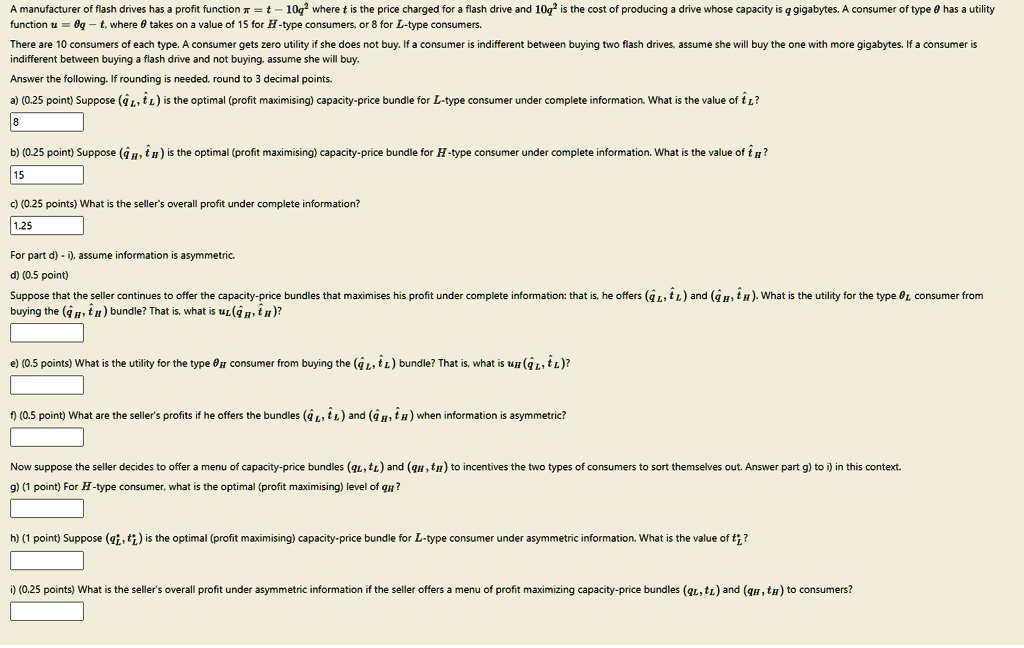
Function u = g(t), where t takes on a value of 15 for -type consumers, or 8 for L-type consumers. There are 10 consumers of each type. A consumer gets zero utility if she does not buy. If a consumer is indifferent between buying two flash drives, assume she will buy the one with more gigabytes. If a consumer is indifferent between buying a flash drive and not buying, assume she will buy. Answer the following. If rounding is needed, round to 3 decimal points.
a) (0.25 point) Suppose (g, t) is the optimal (profit maximizing) capacity-price bundle for -type consumer under complete information. What is the value of g? Answer: 8
b) (0.25 point) Suppose (g, t) is the optimal (profit maximizing) capacity-price bundle for -type consumer under complete information. What is the value of t? Answer: 15
c) (0.25 points) What is the seller's overall profit under complete information? Answer: 1.25
For part d) - i), assume information is asymmetric.
d) (0.5 point) Suppose that the seller continues to offer the capacity-price bundles that maximize his profit under complete information: that is, he offers (g, t) and (g, t). What is the utility for the type - consumer from buying the bundle? That is, what is u(g, t)?
e) (0.5 points) What is the utility for the type consumer from buying the (g, t) bundle? That is, what is u(g, t)?
f) (0.5 point) What are the seller's profits if he offers the bundles (g, t) and (g, t) when information is asymmetric?
Now suppose the seller decides to offer a menu of capacity-price bundles (qi, t.) and (qir, t) to incentivize the two types of consumers to sort themselves out. Answer part g) to i) in this context.
g) (1 point) For -type consumer, what is the optimal (profit maximizing) level of qir?
h) (1 point) Suppose (i, t) is the optimal (profit maximizing) capacity-price bundle for -type consumer under asymmetric information. What is the value of t?
i) (0.25 points) What is the seller's overall profit under asymmetric information if the seller offers a menu of profit maximizing capacity-price bundles (q, t) and (q, t) to consumers?