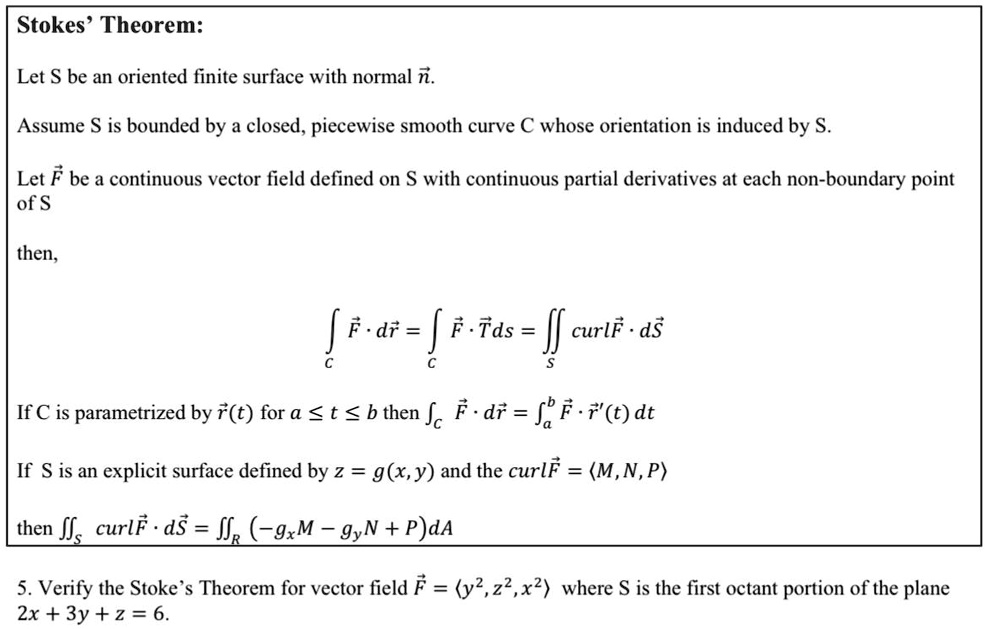
Stokes' Theorem:
Let S be an oriented finite surface with normal vec(n).
Assume S is bounded by a closed, piecewise smooth curve C whose orientation is induced by S.
Let vec(F) be a continuous vector field defined on S with continuous partial derivatives at each non-boundary point of S
then,
∫_C vec(F)*dvec(r)=∫_C vec(F)*vec(T)ds=∬_(S)curlvec(F)*dvec(S)
If C is parametrized by vec(r)(t) for a<=t<=b then ∫_C vec(F)*dvec(r)=∫_a^b vec(F)*vec(r)'(t)dt
If S is an explicit surface defined by z=g(x,y) and the curlvec(F)=(:M,N,P:)
then ∬_(S)curlvec(F)*dvec(S)=∬_(R)(-g_(x)M-g_(y)N+P)dA
5. Verify the Stoke's Theorem for vector field vec(F)=(:y^(2),z^(2),x^(2):) where S is the first octant portion of the plane 2x+3y+z=6.
Stokes' Theorem:
Let S be an oriented finite surface with normal n.
Assume S is bounded by a closed, piecewise smooth curve C whose orientation is induced by S
Let F be a continuous vector field defined on S with continuous partial derivatives at each non-boundary point of S
then,
dr=
F.Tds= curlF.ds
If C is parametrized by(t) for a t b then f.Fdr = JF '(t)dt
If S is an explicit surface defined by z= gx,y) and the curlF=(M,N,P)
then JJs curlFdS=JfR(-gxM-gyN+P)dA
5. Verify the Stoke's Theorem for vector field F = (y2, z2, 2) where S is the first octant portion of the plane 2x+3y+z=6.