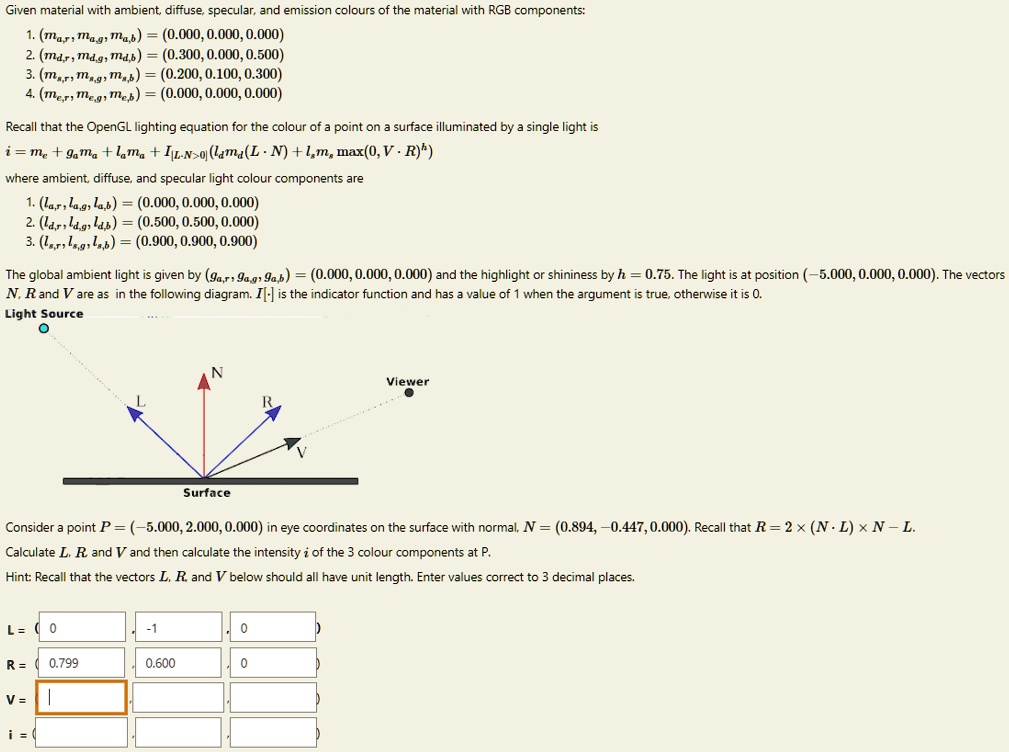
Given material with ambient, diffuse, specular, and emission colours of the material with RGB components:
1. (ma,r,mag,ma,b)=(0.000, 0.000,0.000)
2. (md,rmd,g,ma,b)= (0.300,0.000,0.500)
3. (m,r,ms,g,m,) = (0.200,0.100,0.300)
4. (me,rme,gme,b)=(0.000,0.000,0.000)
Recall that the OpenGL lighting equation for the colour of a point on a surface illuminated by a single light is:
i = me + gamma * la + lambda * (IL * N > 0) * (lambda * N * L + mu * max(0, VR))
where ambient, diffuse, and specular light colour components are:
1. (la,r,ld,g,la,b) = (0.000,0.000,0.000)
2. (la,r,ld,g,la,b) = (0.500,0.500,0.000)
3. (ls,r,ls,glg,b) = (0.900,0.900,0.900)
The global ambient light is given by (ga,r,ga,g,ga,b) = (0.000, 0.000, 0.000) and the highlight or shininess by h = 0.75. The light is at position (5.000, 0.000, 0.000). The vectors NR and V are as in the following diagram. Ij is the indicator function and has a value of 1 when the argument is true, otherwise it is 0.
Light Source
Viewer
Surface
Consider a point P = (5.000, 2.000, 0.000) in eye coordinates on the surface with normal, N = (0.894, 0.447, 0.000). Recall that R = 2 * (N * L) * N - L.
Calculate I, R, and V and then calculate the intensity i of the 3 colour components at P.
Hint: Recall that the vectors I, R, and V below should all have unit length. Enter values correct to 3 decimal places.
L
0
R =
0.799
0.600
V =