Can you solve b, c, d, e and f please
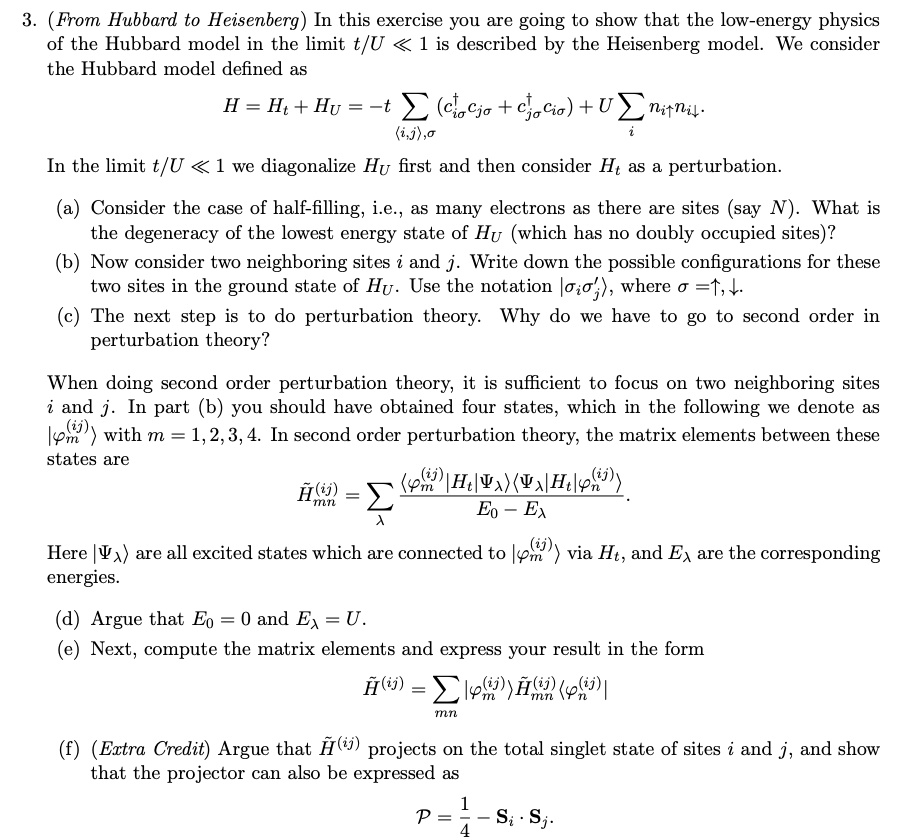
3. (From Hubbard to Heisenberg) In this exercise you are going to show that the low-energy physics of the Hubbard model in the limit t/U < 1 is described by the Heisenberg model. We consider
the Hubbard model defined as
H=H+Hu=-tD(c{ocjo+cjocio)+UDni+ni4 (i,j),0
In the limit t/U < 1 we diagonalize Hu first and then consider Ht as a perturbation.
(a) Consider the case of half-filling, i.e., as many electrons as there are sites (say N). What is the degeneracy of the lowest energy state of Hu (which has no doubly occupied sites)? b) Now consider two neighboring sites i and j. Write down the possible configurations for these two sites in the ground state of Hu. Use the notation [;,), where =,. (c) The next step is to do perturbation theory. Why do we have to go to second order in perturbation theory?
When doing second order perturbation theory, it is sufficient to focus on two neighboring sites i and j. In part (b) you should have obtained four states, which in the following we denote as
states are
(pm)|Hi|Vx)(Vx|Hi|p(ij)y Eo - Ex
H(ij) mn
energies.
(d) Argue that Eo = 0 and E = U. e) Next,compute the matrix elements and express your result in the form
It(ij)=D|p(i)>I(in(p(ij)| mn
(f) (Extra Credit) Argue that H(ij) projects on the total singlet state of sites i and j, and show that the projector can also be expressed as
1
P
Si.Sj. 4