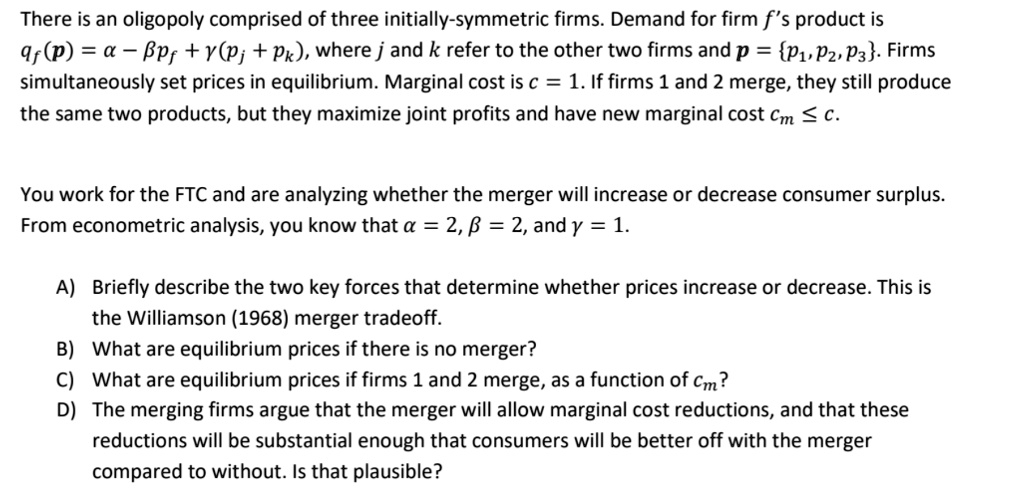
There is an oligopoly comprised of three initially-symmetric firms. Demand for firm f's product is
qf(p) = a - ?pf + y(pj + pk), where j and k refer to the other two firms and p = {p1, p2, p3}. Firms
simultaneously set prices in equilibrium. Marginal cost is c = 1. If firms 1 and 2 merge, they still produce
the same two products, but they maximize joint profits and have new marginal cost $c_m \leq c$.
You work for the FTC and are analyzing whether the merger will increase or decrease consumer surplus.
From econometric analysis, you know that a = 2, ? = 2, and y = 1.
A) Briefly describe the two key forces that determine whether prices increase or decrease. This is
the Williamson (1968) merger tradeoff.
B) What are equilibrium prices if there is no merger?
C) What are equilibrium prices if firms 1 and 2 merge, as a function of $c_m$?
D) The merging firms argue that the merger will allow marginal cost reductions, and that these
reductions will be substantial enough that consumers will be better off with the merger
compared to without. Is that plausible?