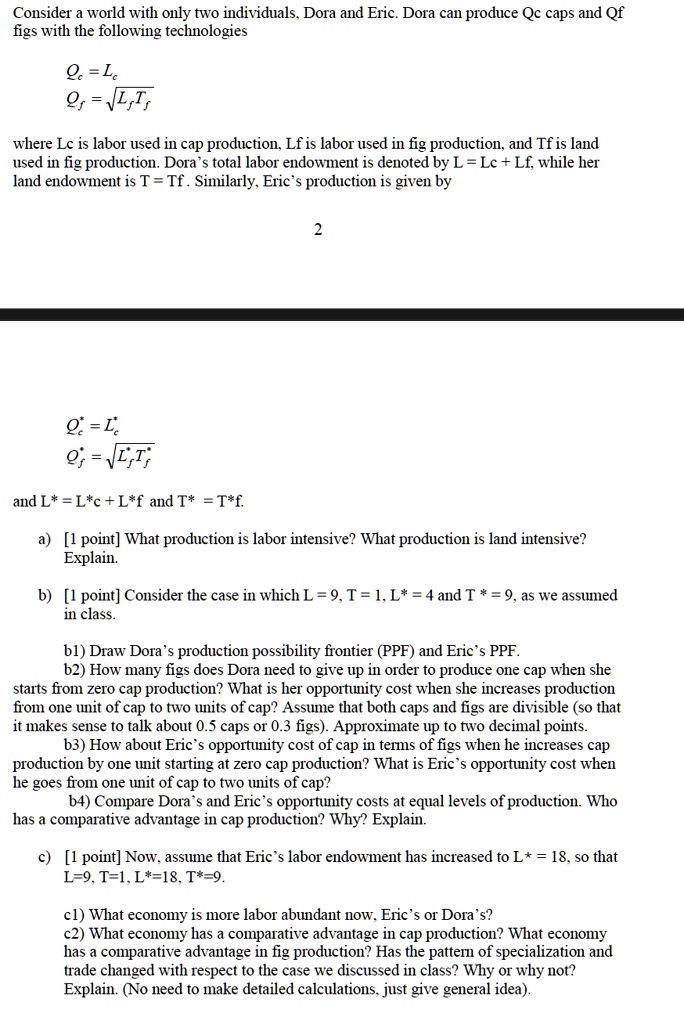
Consider a world with only two individuals, Dora and Eric. Dora can produce Qc caps and Qf
figs with the following technologies
$Q_c = L_c$
$Q_f = \sqrt{L_f T_f}$
where Lc is labor used in cap production, Lf is labor used in fig production, and Tf is land
used in fig production. Dora's total labor endowment is denoted by L = Lc + Lf, while her
land endowment is T = Tf. Similarly, Eric's production is given by
2
$Q_c^* = L_c^*$
$Q_f^* = \sqrt{L_f^* T_f^*}$
and $L^* = L_c^* + L_f^*$ and $T^* = T_f^*$.
a) [1 point] What production is labor intensive? What production is land intensive?
Explain.
b) [1 point] Consider the case in which L = 9, T = 1, L* = 4 and T* = 9, as we assumed
in class.
b1) Draw Dora's production possibility frontier (PPF) and Eric's PPF.
b2) How many figs does Dora need to give up in order to produce one cap when she
starts from zero cap production? What is her opportunity cost when she increases production
from one unit of cap to two units of cap? Assume that both caps and figs are divisible (so that
it makes sense to talk about 0.5 caps or 0.3 figs). Approximate up to two decimal points.
b3) How about Eric's opportunity cost of cap in terms of figs when he increases cap
production by one unit starting at zero cap production? What is Eric's opportunity cost when
he goes from one unit of cap to two units of cap?
b4) Compare Dora's and Eric's opportunity costs at equal levels of production. Who
has a comparative advantage in cap production? Why? Explain.
c) [1 point] Now, assume that Eric's labor endowment has increased to L* = 18, so that
L = 9, T = 1, L* = 18, T* = 9.
c1) What economy is more labor abundant now, Eric's or Dora's?
c2) What economy has a comparative advantage in cap production? What economy
has a comparative advantage in fig production? Has the pattern of specialization and
trade changed with respect to the case we discussed in class? Why or why not?
Explain. (No need to make detailed calculations, just give general idea).