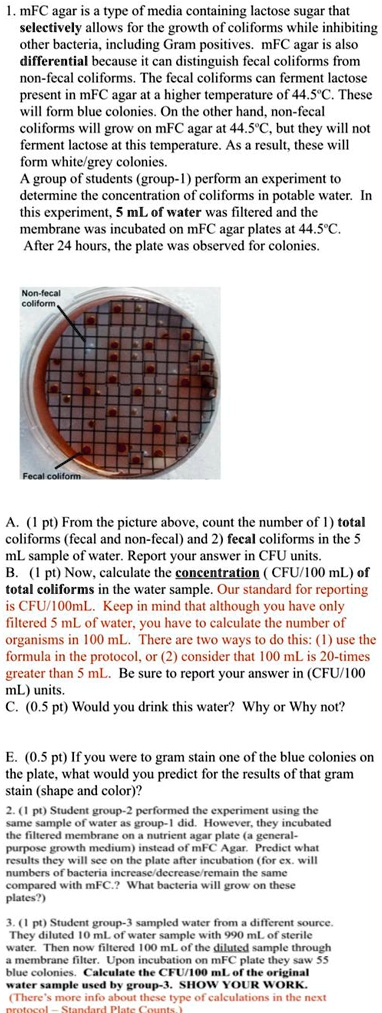
mFC agar is a type of media containing lactose sugar that selectively allows for the growth of coliforms while inhibiting other bacteria, including Gram positives. mFC agar is also differential because it can distinguish fecal coliforms from non-fecal coliforms. The fecal coliforms can ferment lactose present in mFC agar at a higher temperature of 44.5°C. These will form blue colonies. On the other hand, non-fecal coliforms will grow on mFC agar at 44.5°C, but they will not ferment lactose at this temperature. As a result, these will form white/grey colonies.
A group of students (group-1) perform an experiment to determine the concentration of coliforms in potable water. In this experiment, 5 mL of water was filtered and the membrane was incubated on mFC agar plates at 44.5°C. After 24 hours, the plate was observed for colonies.
Non-fecal coliform
A. (1 pt) From the picture above, count the number of total coliforms (fecal and non-fecal) and fecal coliforms in the 5 mL sample of water. Report your answer in CFU units.
B. (1 pt) Now, calculate the concentration CFU/100 mL of total coliforms in the water sample. Our standard for reporting is CFU/100mL. Keep in mind that although you have only filtered 5 mL of water, you have to calculate the number of organisms in 100 mL. There are two ways to do this: 1) use the formula in the protocol, or 2) consider that 100 mL is 20-times greater than 5 mL. Be sure to report your answer in (CFU/100 mL) units.
C. (0.5 pt) Would you drink this water? Why or Why not?
D. (0.5 pt) If you were to gram stain one of the blue colonies on the plate, what would you predict for the results of that gram stain (shape and color)?
Student group-2 performed the experiment using the same sample of water as group-1 did. However, they incubated the filtered membrane on a nutrient agar plate (a general-purpose growth medium) instead of mFC Agar. Predict what results they will see on the plate after incubation (for example, will numbers of bacteria increase/decrease/remain the same compared with mFC.? What bacteria will grow on these plates?
Student group-3 sampled water from a different source. They diluted 10 mL of water sample with 990 mL of sterile water. Then they filtered 100 mL of the diluted sample through a membrane filter. Upon incubation on mFC plate they saw 55 blue colonies. Calculate the CFU/100 mL of the original water sample used by group-3. SHOW YOUR WORK. (There's more info about these type of calculations in the next)