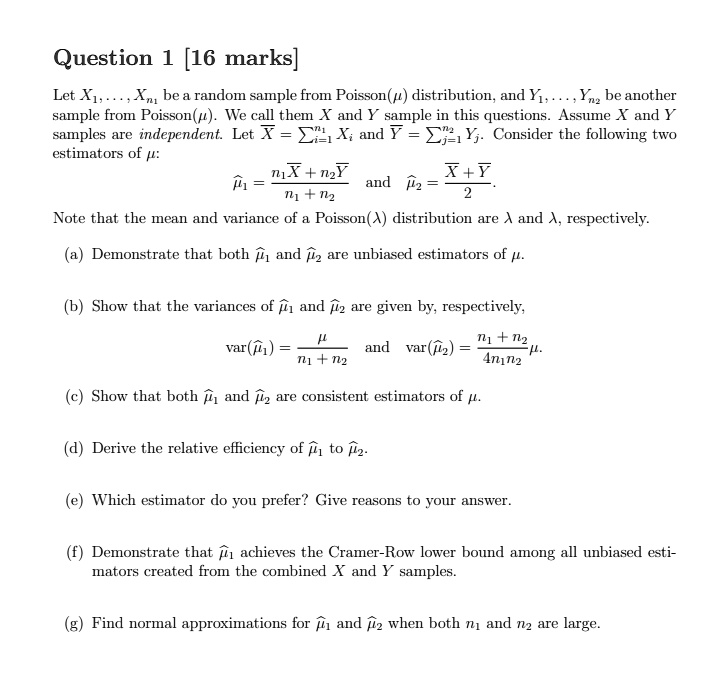
Question 1 [16 marks]
Let $X_1, \dots, X_{n_1}$ be a random sample from Poisson($\mu$) distribution, and $Y_1, \dots, Y_{n_2}$ be another
sample from Poisson($\mu$). We call them $X$ and $Y$ sample in this questions. Assume $X$ and $Y$
samples are independent. Let $X = \sum_{i=1}^{n_1} X_i$ and $Y = \sum_{j=1}^{n_2} Y_j$. Consider the following two
estimators of $\mu$:
$\hat{\mu}_1 = \frac{n_1X + n_2Y}{n_1 + n_2}$ and $\hat{\mu}_2 = \frac{X + Y}{2}$.
Note that the mean and variance of a Poisson($\lambda$) distribution are $\lambda$ and $\lambda$, respectively.
(a) Demonstrate that both $\hat{\mu}_1$ and $\hat{\mu}_2$ are unbiased estimators of $\mu$.
(b) Show that the variances of $\hat{\mu}_1$ and $\hat{\mu}_2$ are given by, respectively,
$\text{var}(\hat{\mu}_1) = \frac{\mu}{n_1 + n_2}$ and $\text{var}(\hat{\mu}_2) = \frac{n_1 + n_2}{4n_1n_2}\mu$.
(c) Show that both $\hat{\mu}_1$ and $\hat{\mu}_2$ are consistent estimators of $\mu$.
(d) Derive the relative efficiency of $\hat{\mu}_1$ to $\hat{\mu}_2$.
(e) Which estimator do you prefer? Give reasons to your answer.
(f) Demonstrate that $\hat{\mu}_1$ achieves the Cramer-Row lower bound among all unbiased esti-
mators created from the combined $X$ and $Y$ samples.
(g) Find normal approximations for $\hat{\mu}_1$ and $\hat{\mu}_2$ when both $n_1$ and $n_2$ are large.