Consider that a differential equation describing the velocity $v$ of a falling mass subject to air resistance proportional to the instantaneous velocity is
$\frac{dv}{dt} = mg - kv$,
where $k > 0$ is a constant of proportionality called the drag coefficient. The positive direction is downward.
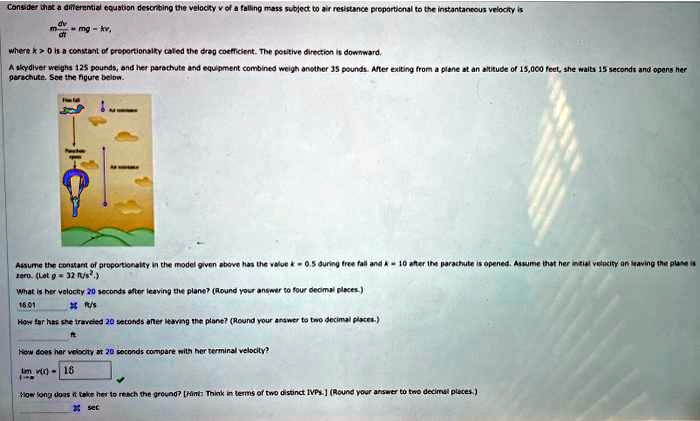
A skydiver weighs 125 pounds, and her parachute and equipment combined weigh another 35 pounds. After exiting from a plane at an altitude of 15,000 feet, she waits 15 seconds and opens her
parachute. See the figure below.
Assume the constant of proportionality in the model given above has the value $k = 0.5$ during free fall and $k = 10$ after the parachute is opened. Assume that her initial velocity on leaving the plane is
zero. (Let $g = 32 \text{ft/}s^2$)
What is her velocity 20 seconds after leaving the plane? (Round your answer to four decimal places.)
16.01
How far has she traveled 20 seconds after leaving the plane? (Round your answer to two decimal places.)
How does her velocity at 20 seconds compare with her terminal velocity?
$\lim_{t \to \infty} v(t) = 16$
How long does it take her to reach the ground? [Hint: Think in terms of two distinct IVPs.] (Round your answer to two decimal places.)
30 sec