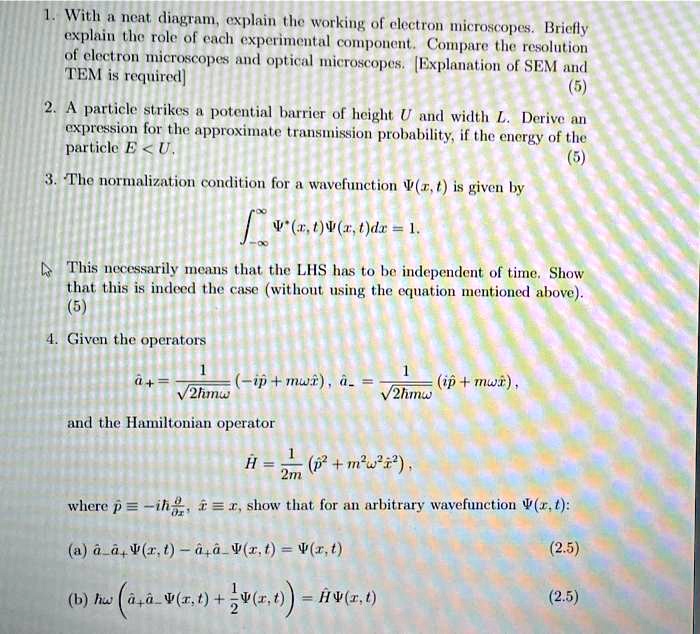
1. With a neat diagram, explain the working of electron microscopes. Briefly
explain the role of each experimental component. Compare the resolution
of electron microscopes and optical microscopes. [Explanation of SEM and
TEM is required]
(5)
2. A particle strikes a potential barrier of height $U$ and width $L$. Derive an
expression for the approximate transmission probability, if the energy of the
particle $E < U$.
(5)
3. The normalization condition for a wavefunction $\Psi(x, t)$ is given by
$\int_{-\infty}^{\infty} \Psi^*(x, t)\Psi(x, t)dx = 1$.
This necessarily means that the LHS has to be independent of time. Show
that this is indeed the case (without using the equation mentioned above).
(5)
4. Given the operators
$a^+ = \frac{1}{\sqrt{2\hbar m\omega}}(-ip + m\omega x)$, $a = \frac{1}{\sqrt{2\hbar m\omega}}(ip + m\omega x)$,
and the Hamiltonian operator
$H = \frac{1}{2m}(p^2 + m^2\omega^2 x^2)$,
where $p = -i\hbar \frac{\partial}{\partial x}$, $x = x$, show that for an arbitrary wavefunction $\Psi(x, t)$:
(a) $a a^+ \Psi(x, t) - a^+ a \Psi(x, t) = \Psi(x, t)$
(2.5)
(b) $\hbar \omega (a^+ a \Psi(x, t) + \frac{1}{2}\Psi(x, t)) = H\Psi(x, t)$
(2.5)