Ace - AI Tutor
Ask Our Educators
Textbooks
My Library
Flashcards
Scribe - AI Notes
Notes & Exams
Download App
John Burns

John B.

Divider

Viewed Questions

A closed organ pipe has a fundamental frequency of $528 \mathrm{~Hz}(\mathrm{a} \mathrm{C}$ note $)$ at $20{ }^{\circ} \mathrm{C}$. What is the fundamental frequency of the pipe when the temperature is $0^{\circ} \mathrm{C} ?$

A closed organ pipe has a fundamental frequency of $528 \mathrm{~Hz}(\mathrm{a} \mathrm{C}$ note $)$ at $20{ }^{\circ} \mathrm{C}$. What is the fundamental frequency of the pipe when the temperature is $0^{\circ} \mathrm{C} ?$

College Physics

A bystander hears a siren vary in frequency from $476 \mathrm{~Hz}$ to $404 \mathrm{~Hz}$ as a fire truck approaches, passes by, and moves away on a straight street ( $\mathbf{r}$ Fig. 14.21 ). What is the speed of the truck? (Take the speed of sound in air to be $343 \mathrm{~m} / \mathrm{s} .$

A bystander hears a siren vary in frequency from $476 \mathrm{~Hz}$ to $404 \mathrm{~Hz}$ as a fire truck approaches, passes by, and moves away on a straight street ( $\mathbf{r}$ Fig. 14.21 ). What is the speed of the truck? (Take the speed of sound in air to be $343 \mathrm{~m} / \mathrm{s} .$

College Physics

A piano tuner using a $264-\mathrm{Hz}$ tuning fork hears 4 beats per second. What are two possible frequencies of vibration of the piano wire?

A piano tuner using a $264-\mathrm{Hz}$ tuning fork hears 4 beats per second. What are two possible frequencies of vibration of the piano wire?

Conceptual Physics

At Cape Canaveral, on blastoff a rocket produces an intensity level of $160 \mathrm{~dB}$ as measured $10 \mathrm{~m}$ from the rocket. What would be the intensity level at $100 \mathrm{~m}$ away? (Assume no energy is lost due to reflections, etc.)

At Cape Canaveral, on blastoff a rocket produces an intensity level of $160 \mathrm{~dB}$ as measured $10 \mathrm{~m}$ from the rocket. What would be the intensity level at $100 \mathrm{~m}$ away? (Assume no energy is lost due to reflections, etc.)

College Physics

Questions asked

ANSWERED

Madeline Alzamora verified

Numerade educator

Ice cream when eaten gives about 2100 calories/kg to the body. On the other hand, the body must give back energy to warm it up to the body temperature (37 °C). Assuming ice cream has similar thermal properties to water (the heat of fusion of ice is 80 kcal/kg): a) 1/2kg produces how much energy in joules for your body? b) 1/2kg absorbs how much energy in joules from your body to reach 37 °C c)what is the net gain or loss of your body eating 1/2kg of ice cream?

View Answer
divider
INSTANT ANSWER

A system undergoes a reversible cycle that traces a triangle in the p-V plane. In the first leg of the cycle, the gas contracts at a constant pressure of 100kPa from 30L to 22L; in the second leg, the pressure increases to 150kPa, with the volume staying constant. In the third leg, the pressure and volume change so that the system follows the straight line that closes the triangle. How much heat is supplied to the system in each cycle?

View Answer
divider
ANSWERED

David Morabito verified

Numerade educator

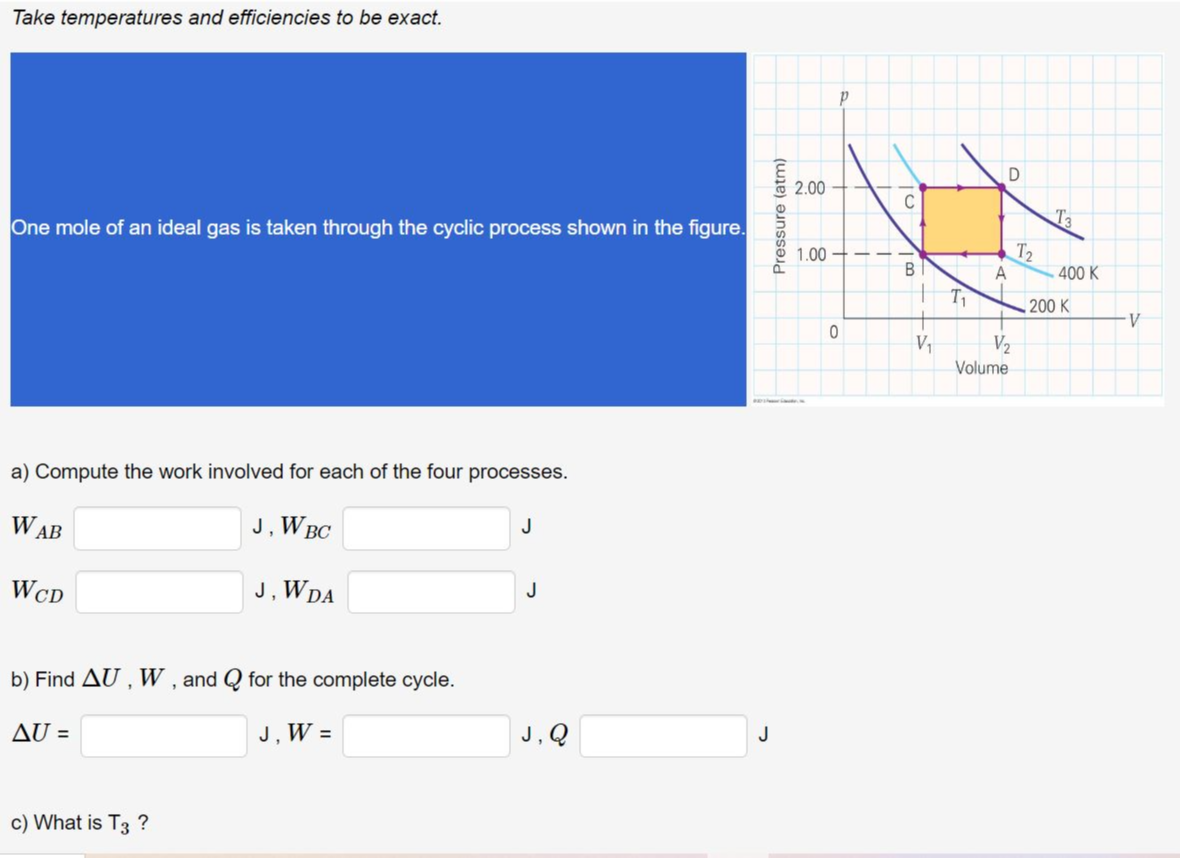
One mole of an ideal gas is taken through the cyclic process shown in the figure. a) Compute the work involved for each of the four processes. [ W_{A B}=square mathrm{J}, W_{B C}=square mathrm{J} ] [ W_{C D}=square mathrm{J}, W_{D A}=square mathrm{J} ] b) Find (Delta U, W), and (Q) for the complete cycle. [ Delta U=square mathrm{J}, W=square mathrm{J}, Q=square mathrm{J} ] c) What is (T_{3})3})3 ?mathrm{T}_{3})?
View Answer
divider