1. 3d electrons in hydrogen [22 pts]
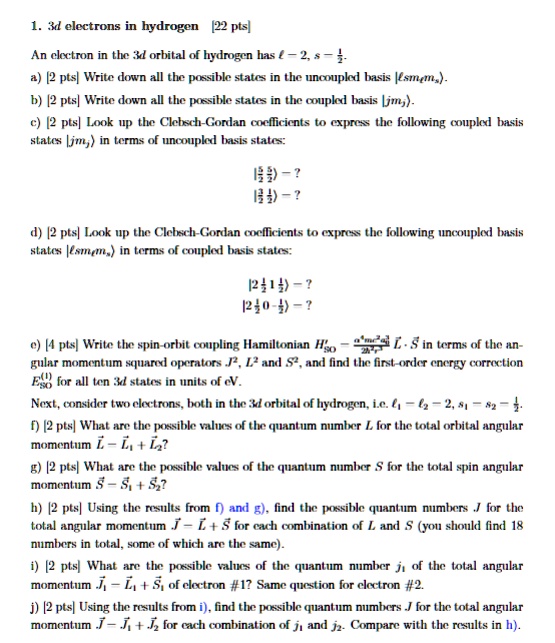
An electron in the 3d orbital of hydrogen has s = 2,
a) [2 pts] Write down all the possible states in the uncoupled basis [smm,).
b) [2 pts] Write down all the possible states in the coupled basis [jm;).
c) [2 pts] Look up the Clebsch-Gordan coefficients to express the following coupled basis states |jm,) in terms of uncoupled basis states:
|3, 3) = |3, 3) =
d) [2 pts] Look up the Clebsch-Gordan coefficients to express the following uncoupled basis states |smem,) in terms of coupled basis states:
|2, 1) = |2, 0) = ?
e) Calculate the expectation values of the orbital angular momentum squared operators J^2, L^2, and S^2, and find the first-order energy correction Eso for all ten 3d states in units of eV. Next, consider two electrons, both in the 3d orbital of hydrogen, i.e. L = 2, S = 1.
f) [2 pts] What are the possible values of the quantum number L for the total orbital angular momentum L = L1 + L2?
g) [2 pts] What are the possible values of the quantum number S for the total spin angular momentum S = S1 + S2?
h) [2 pts] Using the results from f) and g), find the possible quantum numbers J for the total angular momentum J = L + S for each combination of L and S (you should find 18 numbers in total, some of which are the same).
i) [2 pts] What are the possible values of the quantum number j1 of the total angular momentum J1 = L1 + S1 of electron #1? Same question for electron #2.
j) [2 pts] Using the results from i), find the possible quantum numbers J for the total angular momentum J = J1 + J2 for each combination of j1 and j2. Compare with the results in h.