Question 19
<
>
Do college students enjoy playing sports more than watching sports? A researcher randomly
selected ten college students and asked them to rate playing sports and watching sports on a scale
from 1 to 10 with 1 meaning they have no interest and 10 meaning they absolutely love it. The
results of the study are shown below.
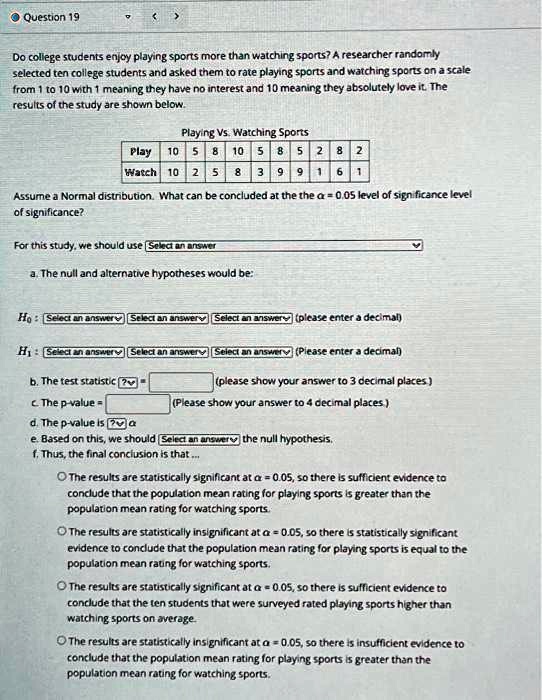
Playing Vs. Watching Sports
Play
10 5 8 10 5 8 5 2 8 2
Watch 10 2 5 8 3 9 9 1 6 1
Assume a Normal distribution. What can be concluded at the the $\alpha = 0.05$ level of significance level
of significance?
For this study, we should use Select an answer
a. The null and alternative hypotheses would be:
$H_0$: Select an answer Select an answer Select an answer (please enter a decimal)
$H_1$: Select an answer Select an answer Select an answer (Please enter a decimal)
b. The test statistic $? =$
(please show your answer to 3 decimal places)
c. The p-value =
(Please show your answer to 4 decimal places.)
d. The p-value is $\alpha$
e. Based on this, we should Select an answer the null hypothesis.
f. Thus, the final conclusion is that...
The results are statistically significant at $\alpha = 0.05$, so there is sufficient evidence to
conclude that the population mean rating for playing sports is greater than the
population mean rating for watching sports.
The results are statistically insignificant at $\alpha = 0.05$, so there is statistically significant
evidence to conclude that the population mean rating for playing sports is equal to the
population mean rating for watching sports.
The results are statistically significant at $\alpha = 0.05$, so there is sufficient evidence to
conclude that the ten students that were surveyed rated playing sports higher than
watching sports on average.
The results are statistically insignificant at $\alpha = 0.05$, so there is insufficient evidence to
conclude that the population mean rating for playing sports is greater than the
population mean rating for watching sports.