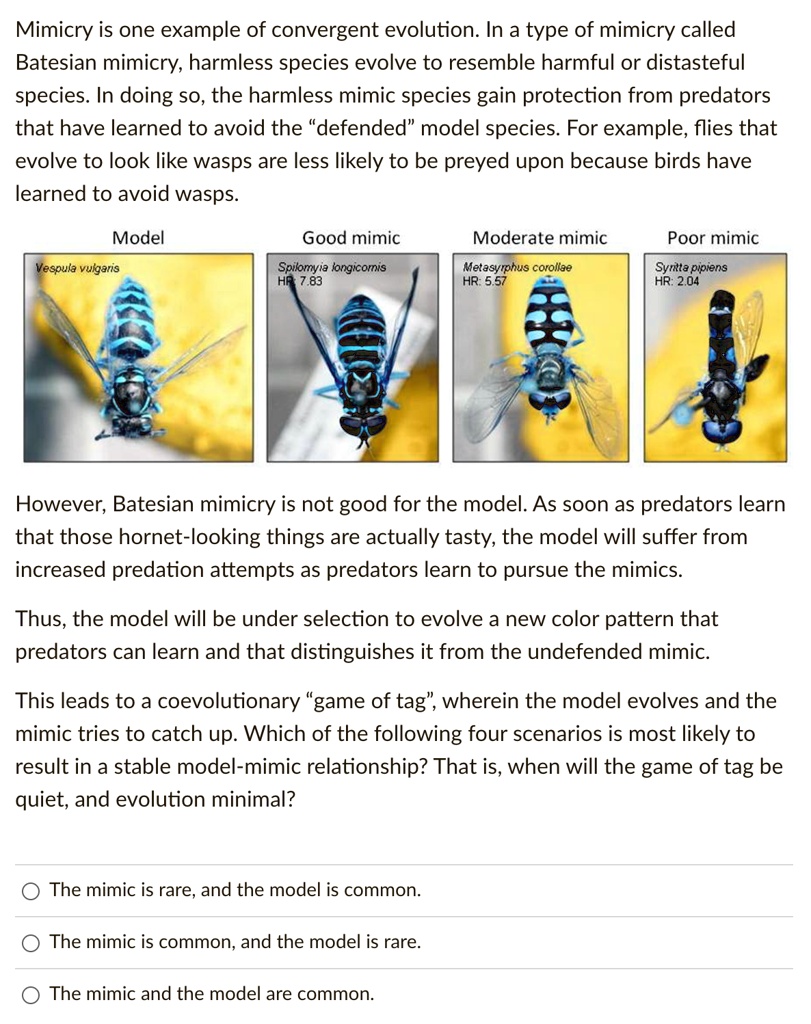
Mimicry is one example of convergent evolution. In a type of mimicry called
Batesian mimicry, harmless species evolve to resemble harmful or distasteful
species. In doing so, the harmless mimic species gain protection from predators
that have learned to avoid the "defended" model species. For example, flies that
evolve to look like wasps are less likely to be preyed upon because birds have
learned to avoid wasps.
Model
Vespula vulgaris
Good mimic
Spilomyia longicornis
HP: 7.83
Moderate mimic
Metasyrphus corollae
HR: 5.57
Poor mimic
Syritta pipiens
HR: 2.04
However, Batesian mimicry is not good for the model. As soon as predators learn
that those hornet-looking things are actually tasty, the model will suffer from
increased predation attempts as predators learn to pursue the mimics.
Thus, the model will be under selection to evolve a new color pattern that
predators can learn and that distinguishes it from the undefended mimic.
This leads to a coevolutionary "game of tag", wherein the model evolves and the
mimic tries to catch up. Which of the following four scenarios is most likely to
result in a stable model-mimic relationship? That is, when will the game of tag be
quiet, and evolution minimal?
The mimic is rare, and the model is common.
The mimic is common, and the model is rare.
The mimic and the model are common.