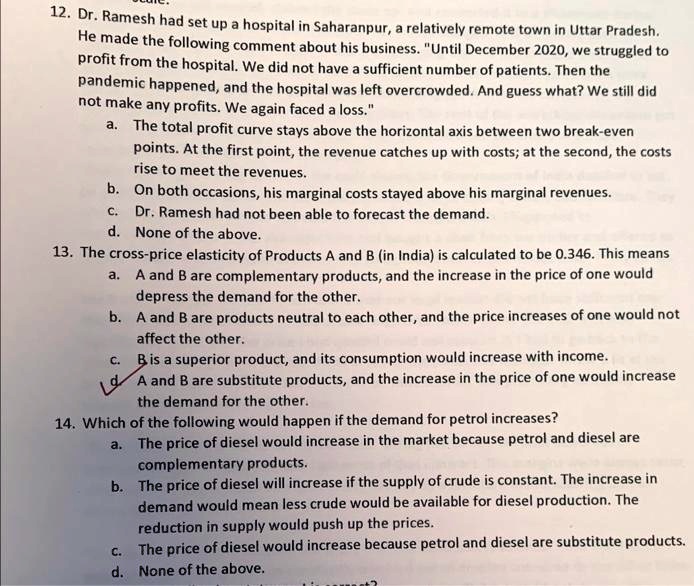
12. Dr. Ramesh had set up a hospital in Saharanpur, a relatively remote town in Uttar Pradesh.
He made the following comment about his business. "Until December 2020, we struggled to
profit from the hospital. We did not have a sufficient number of patients. Then the
pandemic happened, and the hospital was left overcrowded. And guess what? We still did
not make any profits. We again faced a loss."
a. The total profit curve stays above the horizontal axis between two break-even
points. At the first point, the revenue catches up with costs; at the second, the costs
rise to meet the revenues.
b. On both occasions, his marginal costs stayed above his marginal revenues.
c. Dr. Ramesh had not been able to forecast the demand.
d. None of the above.
13. The cross-price elasticity of Products A and B (in India) is calculated to be 0.346. This means
a. A and B are complementary products, and the increase in the price of one would
depress the demand for the other.
b. A and B are products neutral to each other, and the price increases of one would not
affect the other.
c. B is a superior product, and its consumption would increase with income.
?? A and B are substitute products, and the increase in the price of one would increase
the demand for the other.
14. Which of the following would happen if the demand for petrol increases?
a. The price of diesel would increase in the market because petrol and diesel are
complementary products.
b. The price of diesel will increase if the supply of crude is constant. The increase in
demand would mean less crude would be available for diesel production. The
reduction in supply would push up the prices.
c. The price of diesel would increase because petrol and diesel are substitute products.
d. None of the above.