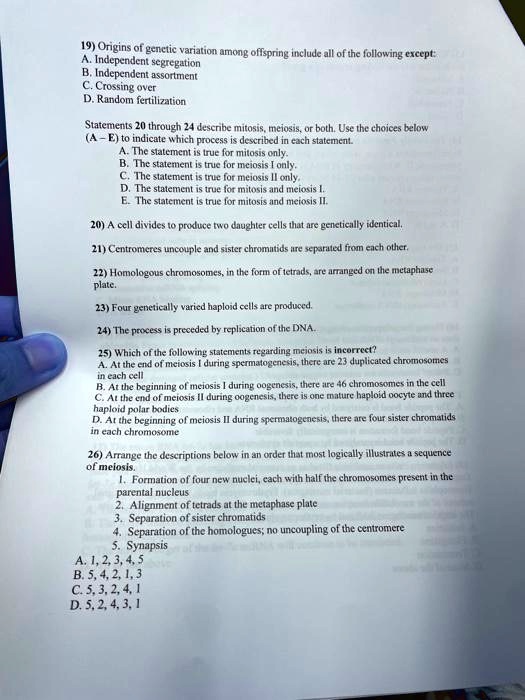
A. Independent segregation B. Independent assortment C. Crossing over D. Random fertilization Statements 20 through 24 describe mitosis, meiosis, or both. Use the choices below AE to indicate which process is described in each statement. A. The statement is true for mitosis only B. The statement is true for meiosis I only. C. The statement is true for meiosis I only D. The statement is true for mitosis and meiosis I. E. The statement is true for mitosis and meiosis II
20 A cell divides to produce two daughter cells that are genetically identical
21 Centromeres uncouple and sister chromatids are separated from each other. 22 Homologous chromosomes, in the form of tetrads, are arranged on the metaphase plate
23 Four genetically varied haploid cells are produced. 24 The process is preceded by replication of the DNA 25 Which of the following statements regarding meiosis is incorrect? A. At the end of meiosis I during spermatogenesis, there are 23 duplicated chromosomes in each cell B. At the beginning of meiosis I during oogenesis, there are 46 chromosomes in the cell C. At the end of meiosis II during oogenesis, there is one mature haploid oocyte and three haploid polar bodies D. At the beginning of meiosis II during spermatogenesis, there are four sister chromatids in each chromosome
26 Arrange the descriptions below in an order that most logically illustrates a sequence of meiosis. .Formation of four new nucleicach with half the chromosomes present in the parental nucleus 2. Alignment of tetrads at the metaphase plate 3. Separation of sister chromatids 4. Separation of the homologues; no uncoupling of the centromere 5. Synapsis A. 1,2,3,4,5 B. 5,4,2,1,3 C. 5,3,2,4,1 D. 5,2,4,3,1