Questions asked
History Question 7 1 pts Syllabus Archive True or False? The three physical states of growth media are selective, differential, and selective & differential. melyCare True False Help
1st attempt Which of the following correct describes the structure of the long fibers of a skeletal muscle? Choose one: one large cell with a single nucleus many cells organized end to end one large cell with many nuclei
When an acid reacts with a metal, what is one of the usual products? hydrogen gas water carbon dioxide salt none of the above
The three wires shown below are equally spaced and carry the same magnitude of current in the directions shown. What is the direction of the net magnetic force on the top (shaded) wire due to the two lower wires? Left Up Down Right The net force is zero
Which of the following statements most accurately describes the Thinking (T) versus Feeling (F) preference in decision-making according to MBTI theory? Thinking types base decisions on personal values and the impact on relationships, while Feeling types rely on logic and objective criteria. Thinking types are more likely to avoid conflict and focus on maintaining group harmony, while Feeling types are more focused on long-term strategic outcomes. Feeling types prioritize harmony and the needs of others when making decisions, while Thinking types prioritize objectivity and logical analysis. Feeling types are more interested in technical and analytical data, while Thinking types focus on emotional and interpersonal dynamics.
prod04-cnow-owl.cengagenow.com OWLv2 I Online teaching and learning resource from Cengage Learning Chat with MARKy I Easy- [Revlow Toples] [Rolorences] Use the References to access important values if needed for this question. A student ran the following reaction in the laboratory at \( 446 \mathrm{~K} \) : \[ \mathrm{PCl}_{5}(\mathrm{~g}) \rightleftharpoons \mathrm{PCl}_{3}(g)+\mathrm{Cl}_{2}(g) \] When she introduced 1.56 moles of \( \mathrm{PCl}_{5}(\mathrm{~g}) \) into a 1.00 liter container, she found the equilibrium concentration of \( \mathrm{PCl}_{5}(\mathrm{~g}) \) to be \( 1.52 \mathrm{M} \). Calculate the equilibrium constant, \( K_{\mathrm{c}} \), she obtained for this reaction. \[ K_{\mathrm{c}}= \] \( \square \) Submit Answer Retry Entire Group 2 more group attempts remaining
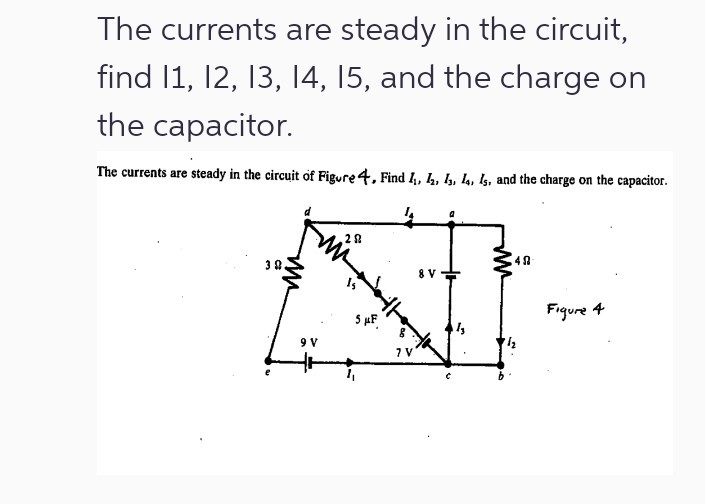
The currents are steady in the circuit, find \( 11,12,13,14,15 \), and the charge on the capacitor. The currents are steady in the circuit of Figure 4, Find \( I_{1}, I_{2}, I_{3}, I_{4}, I_{5} \), and the charge on the capacitor.
A particle located at the origin when t = 1 second moves along the x-axis with velocity v(t) = 6t^2 - t (m/s). State the initial value problem and solve it to find the position s(t) of the particle at time t.
Texts: 22- Since 37 mL of consumption is obtained when a solution containing 250 mg of Na2C2O4 is titrated with a KMnO4 solution with a 1.03 factor, what is the actual concentration of the KMnO4 solution? (Na: 23, C:12, O:16, Mn:55, and K:39 g/mol) a- 0.0222 b- 0.021 c- 0.2 d- 0.0202
Given $V_s = 42 \text{ V}$, use source transformations to simplify the circuit on the left into the form shown on the right. Determine $I_o$ and $R_o$ for the circuit on the right. 3 k$\Omega$ $V_s$ + 6 k$\Omega$ 2 k$\Omega$ $R_L$ $I_o$ $R_o$ $R_L$ A. $I_o = 14 \text{ mA}$, $R_o = 4 \text{ k}\Omega$ B. $I_o = 14 \text{ mA}$, $R_o = 2 \text{ k}\Omega$ C. $I_o = 7 \text{ mA}$, $R_o = 2 \text{ k}\Omega$ D. $I_o = 7 \text{ mA}$, $R_o = 4 \text{ k}\Omega$ E. $I_o = 8 \text{ mA}$, $R_o = 5 \text{ k}\Omega$ F. None of the other answers is correct.