Demand for Complementary and Substitute Goods
D. Demand for a commodity. Note that, in the absence of price changes, the quantity demanded will not change.
P Price
Do Demand
De Demand
X
0
XXXXX Quantity
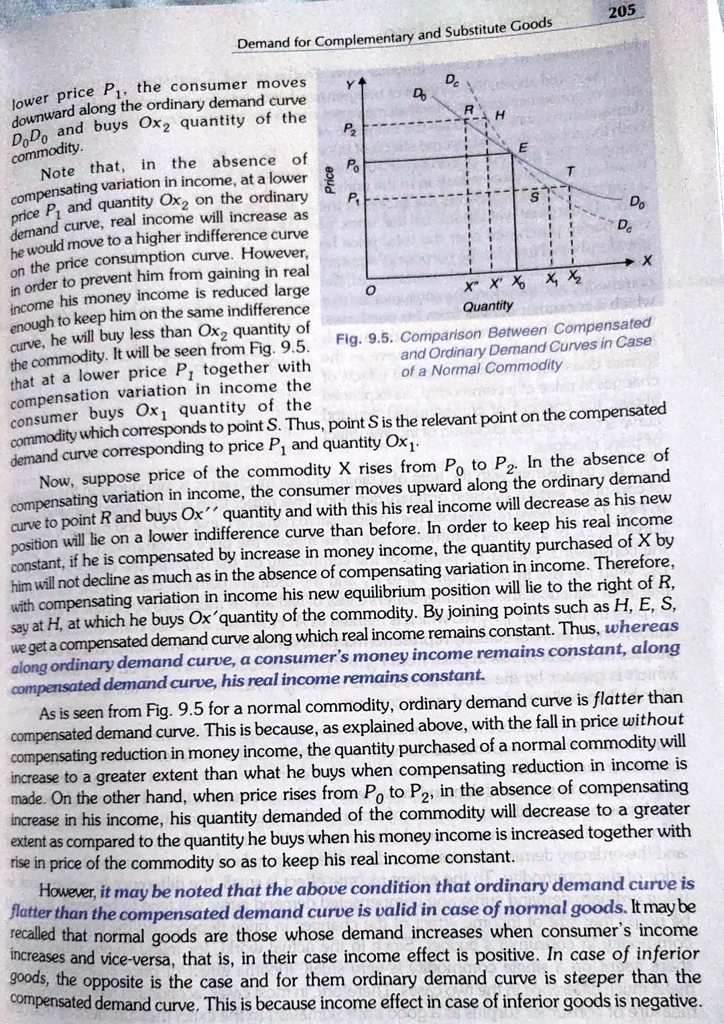
Fig. 9.5. Comparison Between Compensated and Ordinary Demand Curves in Case of a Normal Commodity
Now, suppose the price of the commodity X rises from Po to P. In the absence of compensating variation in income, the quantity demanded will decline. However, with compensating variation in income, the decline in quantity demanded will not be as much. Therefore, with compensating variation in income, the new equilibrium position will lie to the right of R, say at H, at which the consumer buys Ox' quantity of the commodity. By joining points such as H, E, S, we get a compensated demand curve along which real income remains constant. Thus, whereas along the ordinary demand curve, a consumer's money income remains constant, along the compensated demand curve, real income remains constant.
As seen from Fig. 9.5 for a normal commodity, the ordinary demand curve is flatter than the compensated demand curve. This is because, as explained above, with the fall in price without compensating reduction in money income, the quantity purchased of a normal commodity will increase to a greater extent than what is bought when compensating reduction in income is made. On the other hand, when the price rises from Po to P2, in the absence of compensating increase in income, the quantity demanded of the commodity will decrease to a greater extent compared to the quantity bought when the money income is increased together with the rise in price of the commodity to keep the real income constant. However, it may be noted that the above condition, that the ordinary demand curve is flatter than the compensated demand curve, is valid in the case of normal goods.