099661.25
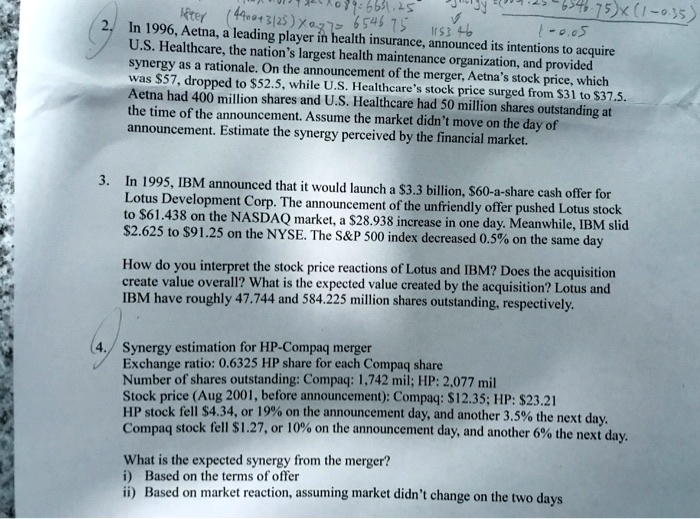
546.75x1-0.35 In 1996, Aetna, a leading player in health insurance, announced its intentions to acquire 153.4x1-0.05 U.S. Healthcare, the nation's largest health maintenance organization, and provided synergy as a rationale. On the announcement of the merger, Aetna's stock price, which was $57, dropped to $52.5, while U.S. Healthcare's stock price surged from $31 to $37.5. Aetna had 400 million shares and U.S. Healthcare had 50 million shares outstanding at the time of the announcement. Assume the market didn't move on the day of announcement. Estimate the synergy perceived by the financial market.
3. In 1995, IBM announced that it would launch a $3.3 billion, $60-a-share cash offer for Lotus Development Corp. The announcement of the unfriendly offer pushed Lotus stock to $61.438 on the NASDAQ market, a $28.938 increase in one day. Meanwhile, IBM slid $2.625 to $91.25 on the NYSE. The S&P 500 index decreased 0.5% on the same day. How do you interpret the stock price reactions of Lotus and IBM? Does the acquisition create value overall? What is the expected value created by the acquisition? Lotus and IBM have roughly 47.744 and 584.225 million shares outstanding, respectively.
Synergy estimation for HP-Compaq merger Exchange ratio: 0.6325 HP share for each Compaq share Number of shares outstanding: Compaq: 1.742 million; HP: 2,077 million Stock price Aug 2001, before announcement): Compaq: $12.35; HP: $23.21
What is the expected synergy from the merger? Based on the terms of the offer.