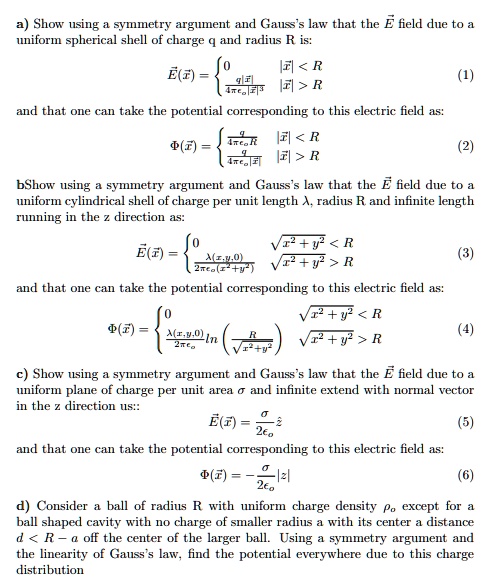
a) Show using a symmetry argument and Gauss's law that the vec(E) field due to a
uniform spherical shell of charge q and radius R is:
vec(E)(vec(x))={(0,|vec(x)|R):}
and that one can take the potential corresponding to this electric field as:
Phi (vec(x))={((q)/(4pi epsi _(o)H),|vec(x)|R):}
bShow using a symmetry argument and Gauss's law that the vec(E) field due to a
uniform cylindrical shell of charge per unit length lambda , radius R and infinite length
running in the z direction as:
vec(E)(vec(x))={(0,sqrt(x^(2)+y^(2))R):}
and that one can take the potential corresponding to this electric field as:
Phi (vec(x))={(0,sqrt(x^(2)+y^(2))R):}
c) Show using a symmetry argument and Gauss's law that the vec(E) field due to a
uniform plane of charge per unit area sigma and infinite extend with normal vector
in the z direction us::
vec(E)(vec(x))=(sigma )/(2epsi lon_(o))hat(z)
and that one can take the potential corresponding to this electric field as:
Phi (vec(x))=-(sigma )/(2epsi lon_(o))|z|
d) Consider a ball of radius R with uniform charge density
ho _(o) except for a
ball shaped cavity with no charge of smaller radius a with its center a distance
d off the center of the larger ball. Using a symmetry argument and
the linearity of Gauss's law, find the potential everywhere due to this charge
distribution
a) Show using a symmetry argument and Gauss's law that the E field due to a uniform spherical shell of charge q and radius R is:
o <R E= q[| (4.|2|3
(1)
and that one can take the potential corresponding to this electric field as:
|<R = (4xc.|| ||>R
(2)
bShow using a symmetry argument and Gauss's law that the E field due to a uniform cylindrical shell of charge per unit length A, radius R and infinite length running in the z direction as:
x2+y2 <R (,v,0) x2 + y2 > R fi+x
E
(3)
and that one can take the potential corresponding to this electric field as:
/x2 + y2 < R /x2 +y2 > R
x
(4)
c) Show using a symmetry argument and Gauss's law that the E field due to a uniform plane of charge per unit area and infinite extend with normal vector in the z direction us: E= (5) 20 and that one can take the potential corresponding to this electric field as:
20
(6)
d) Consider a ball of radius R with uniform charge density Po except for a ball shaped cavity with no charge of smaller radius a with its center a distance d < R - off the center of the larger ball. Using a symmetry argument and the linearity of Gauss's law, find the potential everywhere due to this charge distribution