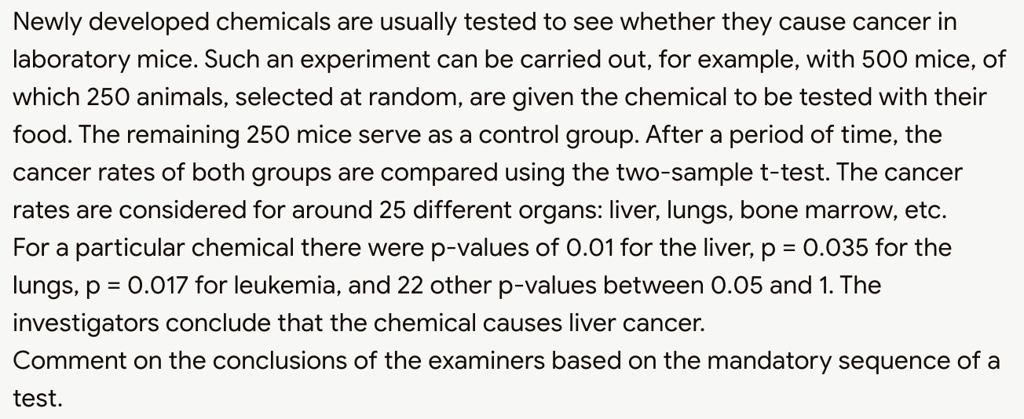
Newly developed chemicals are usually tested to see whether they cause cancer in
laboratory mice. Such an experiment can be carried out, for example, with 500 mice, of
which 250 animals, selected at random, are given the chemical to be tested with their
food. The remaining 250 mice serve as a control group. After a period of time, the
cancer rates of both groups are compared using the two-sample t-test. The cancer
rates are considered for around 25 different organs: liver, lungs, bone marrow, etc.
For a particular chemical there were p-values of 0.01 for the liver, p = 0.035 for the
lungs, p = 0.017 for leukemia, and 22 other p-values between 0.05 and 1. The
investigators conclude that the chemical causes liver cancer.
Comment on the conclusions of the examiners based on the mandatory sequence of a
test.