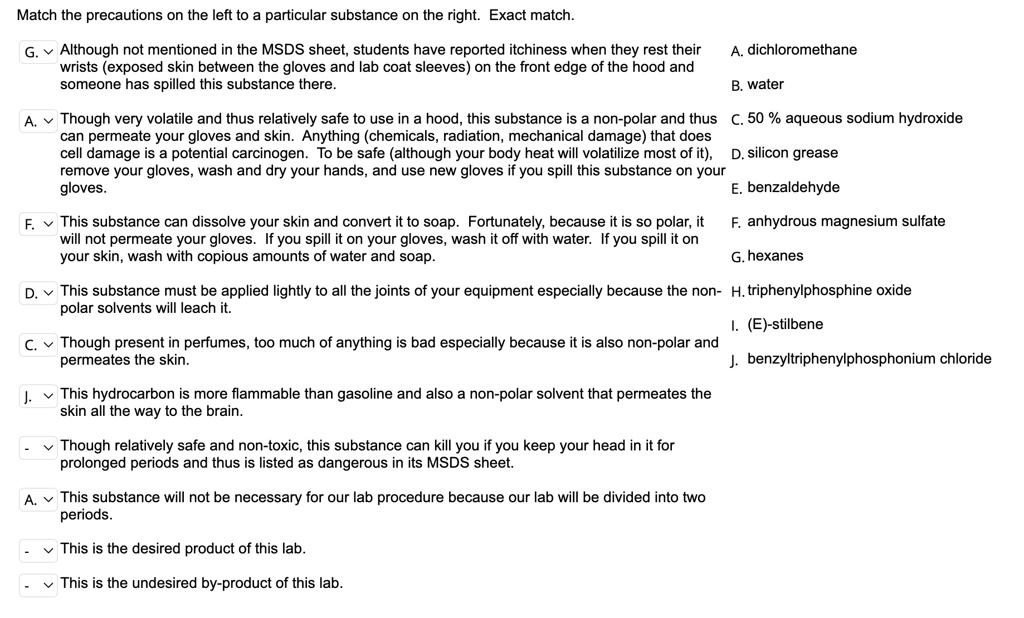
Match the precautions on the left to a particular substance on the right. Exact match.
G. Although not mentioned in the MSDS sheet, students have reported itchiness when they rest their
wrists (exposed skin between the gloves and lab coat sleeves) on the front edge of the hood and
someone has spilled this substance there.
A. Though very volatile and thus relatively safe to use in a hood, this substance is a non-polar and thus
can permeate your gloves and skin. Anything (chemicals, radiation, mechanical damage) that does
cell damage is a potential carcinogen. To be safe (although your body heat will volatilize most of it),
remove your gloves, wash and dry your hands, and use new gloves if you spill this substance on your
gloves.
F. This substance can dissolve your skin and convert it to soap. Fortunately, because it is so polar, it
will not permeate your gloves. If you spill it on your gloves, wash it off with water. If you spill it on
your skin, wash with copious amounts of water and soap.
D. This substance must be applied lightly to all the joints of your equipment especially because the non-
polar solvents will leach it.
C. Though present in perfumes, too much of anything is bad especially because it is also non-polar and
permeates the skin.
J. This hydrocarbon is more flammable than gasoline and also a non-polar solvent that permeates the
skin all the way to the brain.
Though relatively safe and non-toxic, this substance can kill you if you keep your head in it for
prolonged periods and thus is listed as dangerous in its MSDS sheet.
A. This substance will not be necessary for our lab procedure because our lab will be divided into two
periods.
This is the desired product of this lab.
This is the undesired by-product of this lab.
A. dichloromethane
B. water
C. 50% aqueous sodium hydroxide
D. silicon grease
E. benzaldehyde
F. anhydrous magnesium sulfate
G. hexanes
H. triphenylphosphine oxide
I. (E)-stilbene
J. benzyltriphenylphosphonium chloride