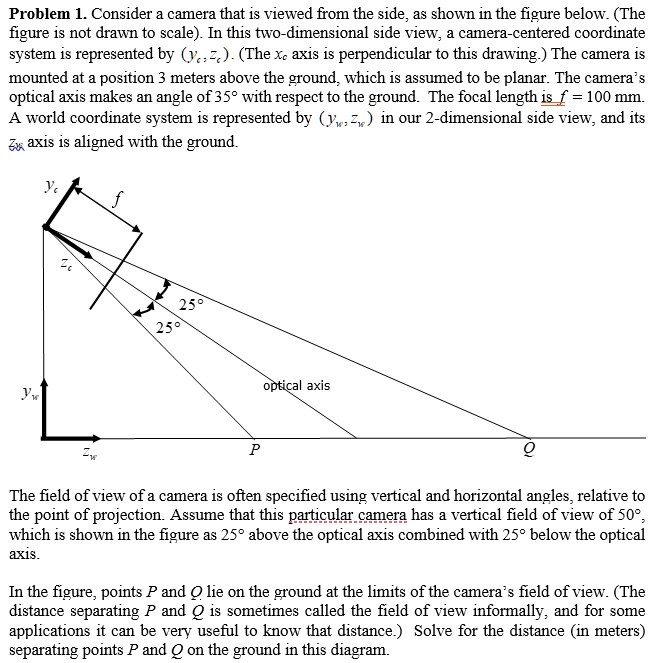
Problem 1. Consider a camera that is viewed from the side, as shown in the figure below. (The figure is not drawn to scale). In this two-dimensional side view, a camera-centered coordinate system is represented by ($y_c, z_c$). (The $x_c$ axis is perpendicular to this drawing.) The camera is mounted at a position 3 meters above the ground, which is assumed to be planar. The camera's optical axis makes an angle of 35° with respect to the ground. The focal length is $f = 100$ mm. A world coordinate system is represented by ($y_w, z_w$) in our 2-dimensional side view, and its $z_w$ axis is aligned with the ground.
The field of view of a camera is often specified using vertical and horizontal angles, relative to the point of projection. Assume that this particular camera has a vertical field of view of 50°, which is shown in the figure as 25° above the optical axis combined with 25° below the optical axis.
In the figure, points $P$ and $Q$ lie on the ground at the limits of the camera's field of view. (The distance separating $P$ and $Q$ is sometimes called the field of view informally, and for some applications it can be very useful to know that distance.) Solve for the distance (in meters) separating points $P$ and $Q$ on the ground in this diagram.