Ace - AI Tutor
Ask Our Educators
Textbooks
My Library
Flashcards
Scribe - AI Notes
Notes & Exams
Download App
john salas

john s.

Divider

Questions asked

BEST MATCH

4. Guanine complementarily binds with cytosine and forms [Select] [Select] bonds.

View Answer
divider
BEST MATCH

20. The circuit in Fig. 11.36 has a series resistance of $R_s = 50 \, \Omega$ and load resistance of $R_L = 82 \, \Omega$. If the impedance of the inductor is $j40 \, \Omega$, what would be the required impedance of the capacitor to ensure maximum power transfer to $R_L$?

View Answer
divider
BEST MATCH

A mouse with an $ob/ob$ genotype lacks functional leptin. A second mouse with a $db/db$ genotype lacks functional leptin receptors. Both mice have been allowed to feed at will. It is most likely that both the $ob/ob$ mouse and the $db/db$ mouse will be obese. the $ob/ob$ mouse will be obese and the $db/db$ mouse will be thin. the $ob/ob$ mouse will be thin and the $db/db$ mouse will be obese. both the $ob/ob$ mouse and the $db/db$ mouse will be thin. the $ob/ob$ mouse will be obese and the $db/db$ mouse will be a normal weight.

View Answer
divider
BEST MATCH

Use the Le Châtelier's principle interactive to answer these questions. For the reaction where $\Delta n = -1$, what happens after in increase in volume? $Q < K$ so the reaction shifts toward products. $Q = K$ so the reaction does not shift. $Q > K$ so the reaction shifts toward reactants. For the reaction where $\Delta n = 0$, what happens after in increase in volume? $Q < K$ so the reaction shifts toward products. $Q = K$ so the reaction does not shift. $Q > K$ so the reaction shifts toward reactants. For the reaction where $\Delta n = +1$, what happens after in increase in volume? $Q < K$ so the reaction shifts toward products. $Q = K$ so the reaction does not shift. $Q > K$ so the reaction shifts toward reactants.

View Answer
divider
BEST MATCH

Complete the following statement: Today, the standard unit of mass is defined in terms of

View Answer
divider
BEST MATCH

THREATS TO GROUP EFFECTIVENESSA group member does not think (does not know) whether or that others in the group are working on the task (or how hard they are working on the task).The group member may feel that s/he does not have a unique skill to devote to the group effort.

View Answer
divider
BEST MATCH

Based on the Physiology of the menstrual cycle and the function life span of the ovum and the sperm.?

View Answer
divider
BEST MATCH

While fear is typically a reaction in response to a perceived stimulus, anxiety is known to occur in anticipation of a threatening or vague event. Question 2 options: True False

View Answer
divider
BEST MATCH

Given string userString1 on one line and string userString2 on a second line, assign lengthDiff with the length of the shorter string subtracted from the length of the longer string. Ex: If the input is: ice pancakes then the output is: 5 1 import java.util.Scanner; 2 3 public class StringSize { 4 public static void main(String[] args) { 5 Scanner scnr = new Scanner(System.in); 6 String userString1; 7 String userString2; 8 int lengthDiff; 9 10 userString1 = scnr.nextLine(); 11 userString2 = scnr.nextLine(); 12 13 /* Your code goes here */ 14 System.out.println(lengthDiff); 15 1 2 3

View Answer
divider
BEST MATCH

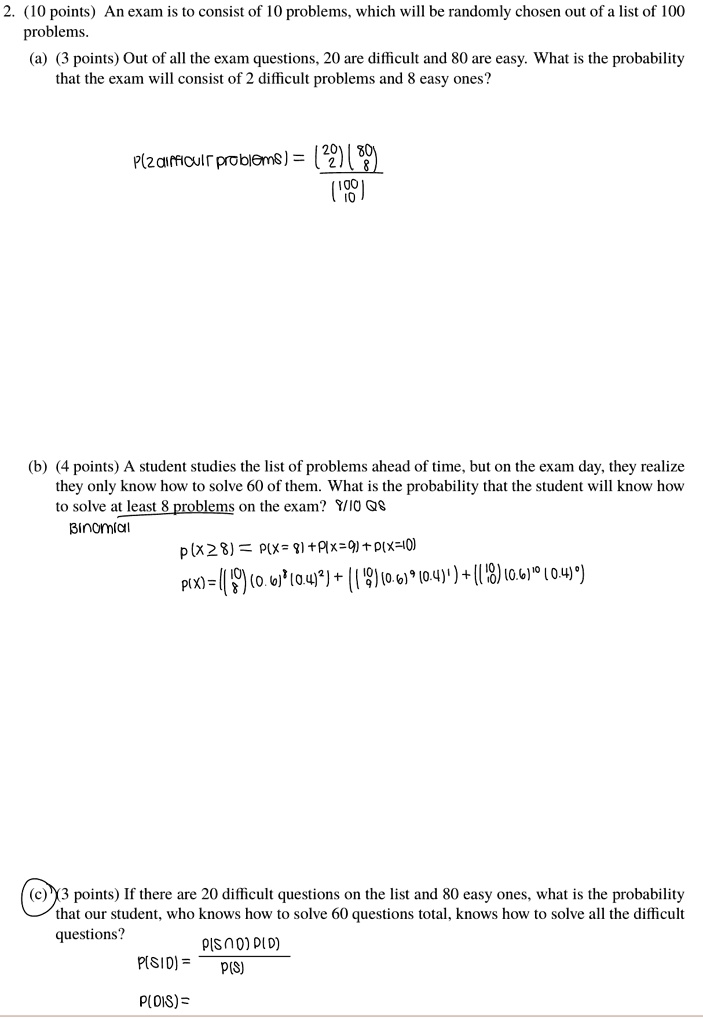
2. (10 points) An exam is to consist of 10 problems, which will be randomly chosen out of a list of 100 problems. (a) (3 points) Out of all the exam questions, 20 are difficult and 80 are easy. What is the probability that the exam will consist of 2 difficult problems and 8 easy ones? $P(2 \text{ difficult problems}) = \frac{\binom{20}{2} \binom{80}{8}}{\binom{100}{10}}$ (b) (4 points) A student studies the list of problems ahead of time, but on the exam day, they realize they only know how to solve 60 of them. What is the probability that the student will know how to solve at least 8 problems on the exam? 8/10 QS Binomial $p(x \ge 8) = p(x=8) + p(x=9) + p(x=10)$ $p(x) = \binom{10}{8} (0.6)^8 (0.4)^2 + \binom{10}{9} (0.6)^9 (0.4)^1 + \binom{10}{10} (0.6)^{10} (0.4)^0$ (c) (3 points) If there are 20 difficult questions on the list and 80 easy ones, what is the probability that our student, who knows how to solve 60 questions total, knows how to solve all the difficult questions? $P(S|D) = \frac{P(S \cap D)}{P(S)}$ $P(D|S) = $
View Answer
divider