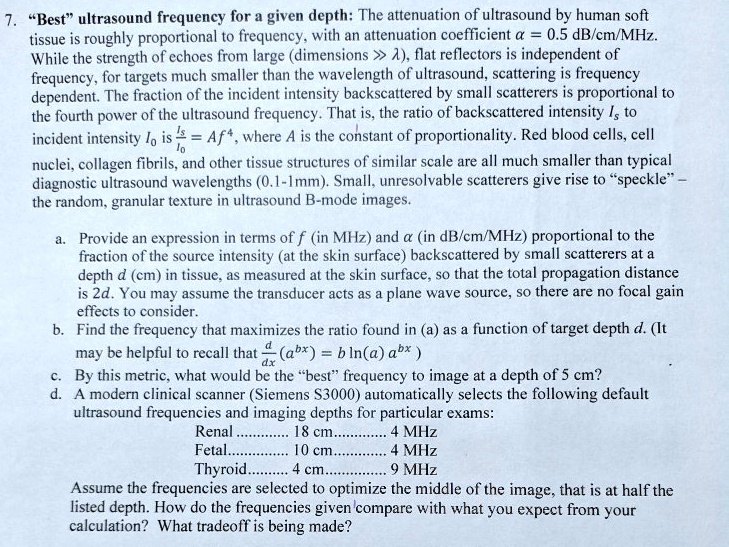
Best ultrasound frequency for a given depth: The attenuation of ultrasound by human soft tissue is roughly proportional to frequency, with an attenuation coefficient a = 0.5 dB/cm/MHz. While the strength of echoes from large dimensions ( > ), flat reflectors is independent of frequency, for targets much smaller than the wavelength of ultrasound, scattering is frequency dependent. The fraction of the incident intensity backscattered by small scatterers is proportional to the fourth power of the ultrasound frequency. That is, the ratio of backscattered intensity Is to incident intensity lo is = Af where A is the constant of proportionality. Red blood cells, cell nuclei, collagen fibrils, and other tissue structures of similar scale are all much smaller than typical diagnostic ultrasound wavelengths (0.1-1mm). Small, unresolvable scatterers give rise to "speckle," the random, granular texture in ultrasound B-mode images.
a. Provide an expression in terms of f in MHz and a in dB/cm/MHz proportional to the fraction of the source intensity at the skin surface backscattered by small scatterers at a depth d (cm) in tissue, as measured at the skin surface, so that the total propagation distance is 2d. You may assume the transducer acts as a plane wave source, so there are no focal gain effects to consider.
b. Find the frequency that maximizes the ratio found in a as a function of target depth d. It may be helpful to recall that abx = b lnaabx C. By this metric, what would be the best frequency to image at a depth of 5 cm?
d. A modern clinical scanner (Siemens S3000) automatically selects the following default ultrasound frequencies and imaging depths for particular exams:
- Renal... 18 cm... 4 MHz
- Fetal... 10 cm... 4 MHz
- Thyroid... 4 cm... 9 MHz
Assume the frequencies are selected to optimize the middle of the image, that is at half the listed depth. How do the frequencies given compare with what you expect from your calculation? What tradeoff is being made?